


[Full-Version] 2021 New Dumpexams 300-510 PDF Recently Updated Questions
300-510 Exam with Guarantee Updated 104 Questions
Introduction to Implementing Cisco Service Provider Advanced Routing Solutions (300-510 SPRI) Exam
It is a 90-minute test affiliated with the CCNP Service Provider and Cisco Accredited Professional-Service Provider VPN Services Implementation certifications. Implementing Cisco Service Provider Advanced Routing Solutions (300-510 SPRI) exam tests the candidate’s knowledge of integrating VPN services, including Layer 2, Layer 3, and IPv6, from the service provider. Different types of 310-510 SPRI practice test helps the students to prepare for the exam.
The benefit of obtaining the Implementing Cisco Service Provider Advanced Routing Solutions (300-510 SPRI) Exam Certification
The Cisco Service Provider VPN Services (300â515 SPRI) test is not simpler and unless well prepared, can prove to be a very tough exam. If competent 300-510 SPRI exam dumps are researched and evaluated on 300-510 SPRI practice exams, the exam difficulty can be reduced. The benefits are listed below:
- Cisco certifications improve job productivity
- Cisco certifications improve career prospects
- Cisco certified professionals can manage complex projects and issues
- If the applicant has the desire to transfer into a company to a higher-paying role. As always, this credential will help.
- Cisco certified professionals can provide a higher level of customer satisfaction
- Cisco certifications improve earning
The 300-510 SPRI exam certifies your knowledge of implementing service provider advanced routing technologies including routing protocols, policy language, MPLS, and segment routing. After you pass 300-510 SPRI, you earn the Cisco Certified Specialist - Service Provider Advanced Routing Implementation certification, and you satisfy the concentration exam requirement for the CCNP Service Provider certification.
NEW QUESTION 53
In a PIM-SM environment, which mechanism determines the traffic that a receiver receives?
- A. The receiver explicitly requests its desired traffic from the RP on the shared tree.
- B. The RP on the shared tree floods traffic out of all PIM configured interfaces.
- C. The receiver explicitly requests traffic from each desired source, which responds by sending all traffic.
- D. The receiver explicitly requests traffic from a single source, which responds by forwarding all traffic.
Answer: C
NEW QUESTION 54
Refer to the exhibit.
Why is neighbor 10.1.5.5 stuck in "2WAY" state?
- A. Router ID 10.1.5.5 is not reachable from R2
- B. OSPF authentication has failed between R2 and 10.1.5.5
- C. It is an expected behavior when OSPF network type is broadcast
- D. OSPF parameters (Area ID or hello interval) are mismatched between R2 and 10.1.5.5
Answer: C
Explanation:
Reference:
https://www.cisco.com/c/en/us/support/docs/ip/open-shortest-path-first-ospf/13683-11.html
NEW QUESTION 55
Which cost is the default when redistributing routes from BGP to OSPF?
- A. 0
- B. automatic
- C. infinite
- D. 1
Answer: A
Explanation:
Reference:
http://www.ciscopress.com/articles/article.asp?p=27573
NEW QUESTION 56
Compare different features between OSPFv2 and OSPFv3. Drag and drop the descriptions of OSPF from the left onto the correct OSPF versions on the right.
Answer:
Explanation:

NEW QUESTION 57
Which output from the show isis interface command helps an engineer troubleshoot an IS-IS adjacency problem on a Cisco IOS-XR platform?
- A. metric
- B. circuit type
- C. priority
- D. hello interval
Answer: D
NEW QUESTION 58
Refer to the exhibit.
Router 1 has attempted to establish a Cisco MPLS TE tunnel to router 2, but the tunnel has failed. Which statement about this configuration is true?
- A. Router 1 and router 2 must define the RSVP bandwidth reserved on the physical interfaces
- B. Router 1 must have Cisco MPLS TE enabled on interface gigabitethernet0/1
- C. Router 1 must define an explicit path to router 2
- D. Router 2 must have a tunnel interface created with router 1 as the destination
Answer: B
NEW QUESTION 59
Refer to the exhibit.
A network operator is working to deploy a Unified BGP design and allow it to be available only in selected markets and services in the future. The label allocation is not functioning as desired. Which action will fix the issue?
- A. Remove the route policy and only configure "allocate-label".
- B. Reconfigure the route-policy ALL_LABELS to match all after the drop.
- C. Remove the allocate-labels command.
- D. Reconfigure the route-policy ALL_LABELS to pass.
Answer: D
NEW QUESTION 60
Refer to the exhibit.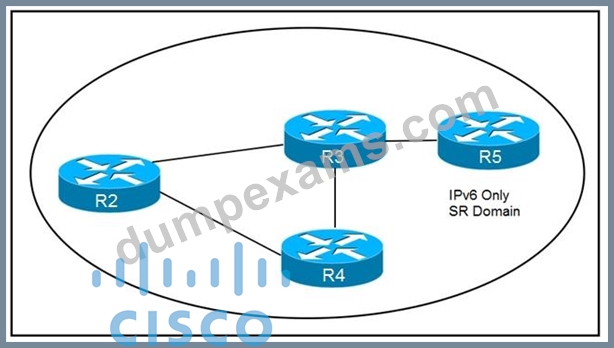
How are packets directed through the data plane when SRv6 is implemented?
- A. The MPLS data plane is used to push labels onto IGP routes
- B. An ordered list of segments is encoded in a routing extension header
- C. The packet is encapsulated with a header and trailer encoding the ordered list of segments
- D. A stack of labels represents an ordered list of segments
Answer: B
NEW QUESTION 61
Refer to the exhibit.
R1 is directly connected to R2 and R3. R1 is in BGP AS 123, R2 is in BGP AS 2, and R3 is in BGP AS 3. Assume that there is no connectivity issue between R1, R2 and R1, R3. Which result between BGP peers R1, R2 and R1, R3 is true?
- A. The BGP session does not come up between R1 and R2 and between R1 and R3.
- B. The BGP session comes up between R1 and R2 and between R1 and R3.
- C. The BGP session comes up between R1 and R2, but not between R1 and R3.
- D. The BGP session comes up between R1 and R3, but not between R1 and R2.
Answer: B
NEW QUESTION 62
Refer to the exhibit.
An administrator is troubleshooting Internet access issues on a customer's network. After applying this ISIS configuration to R1, the administrator notices that it fails to redistribute the default route into IS-IS. After checking the connectivity between the ISIS router and the ISP router the engineer confirmed there is Layer 3 connectivity between them Which action should be taken to correct the problem?
- A. Configure the default route under any routing protocol other than IS-IS
- B. Associate the default route with a VRF
- C. Configure R1 as a Layer 1 router
- D. Add the default-information originate command to the configuration
Answer: D
NEW QUESTION 63
Refer to the exhibit.
Which attribute can router 1 alter so that only other iBGP peers prefer to use 192.168.4.2 as the next hop for route 192.168.3.0/24?
- A. MED
- B. origin
- C. local preference
- D. weight
Answer: A
NEW QUESTION 64
Refer to the exhibit.
A network operator must inject a Level 1 route from XR2 (10.16.16.0/24) into the ISIS topology. Which configuration allows the injection in a way that XR3 and XR1 have a valid and working route for 10.16.16.0/24?

- A. Option C
- B. Option B
- C. Option D
- D. Option A
Answer: A
NEW QUESTION 65
Which two statements about route reflectors are true? (Choose two.)
- A. If a route reflector receives a route with a cluster-list attribute containing a different cluster ID, the route is discarded.
- B. Routes received from nonclient peers are reflected to route reflector cluster as well as OSPF peers.
- C. Routes received from a route reflector client is reflected to other clients and nonclient peers.
- D. If a router received an iBGP route with the originator-ID attribute set to its own router ID, the route is discarded.
- E. Routes received from nonclient peers are reflected to route reflector clients as well as nonclient peers.
Answer: C,D
Explanation:
Explanation/Reference: http://www.networkers-online.com/blog/2009/02/bgp-route-reflector-basics/
NEW QUESTION 66 
Refer to the exhibit. A network operator is getting the route for 10.11.11 0/24 from two upstream providers on
#XR3. The network operator must configure #XR3 to force the 10.11.11.0/24 prefix to route via next hop of
10.0.0.9 as primary when available. Which of these can the operator use the routing policy language for, to enforce this traffic forwarding path?
- A. lower local preference on the prefix coming from 192.168.0.2
- B. weight of 100 on the prefix coming from 192.168.0.1
- C. higher local preference on the prefix coming from 192.168.0.1
- D. weight of 0 on the prefix coming from 192.168.0.2
Answer: C
NEW QUESTION 67
Refer to the exhibit.
A network operator must stop 10.33.33.33/32 from being redistributed into Level 1 router XR1. Which configuration meets this need?


- A. Option C
- B. Option B
- C. Option D
- D. Option A
Answer: A
NEW QUESTION 68 
Refer to the exhibit. P1 and PE3 Cisco IOS XR routers are directly connected and have this configuration applied. The BGP session is not coming up. Assume that there is no IP reachability problem and both routers can open tcp port 179 to each other. Which two actions fix the issue? (Choose two.)
- A. Change MD5 to HMAC-MD5
- B. Remove the send and accept lifetime under key 1
- C. Change MD5 to SHA-1
- D. Change MD5 to HMAC-ESP
- E. Change MD5 to HMAC-SHA1-12
Answer: A,E
Explanation:
Explanation/Reference: https://www.cisco.com/c/en/us/td/docs/routers/crs/software/crs_r4-0/security/configuration/guide/ sc40crsbook_chapter5.html
NEW QUESTION 69
Refer to the exhibit.
P1 and PE3 Cisco IOS XR routers are directly connected and have this configuration applied. The BGP session is not coming up. Assume that there is no IP reachability problem and both routers can open tcp port 179 to each other. Which two actions fix the issue? (Choose two.)
- A. Change MD5 to HMAC-MD5
- B. Remove the send and accept lifetime under key 1
- C. Change MD5 to SHA-1
- D. Change MD5 to HMAC-ESP
- E. Change MD5 to HMAC-SHA1-12
Answer: A,E
NEW QUESTION 70
Which difference should be considered when intradomain or interdomain multicast routing is implemented?
- A. Interdomain multicast routing requires an IS-IS or OSPF neighbor relationship between the domains but intradomain multicast routing requires only BGP
- B. interdomain multicast routing uses BIDR-PIM to establish neighbor relationships between AS and interdomain multicast routing uses MSDP
- C. Interdomain multicast routing relies on PIM-DM and intradomain multicast routing relies on PIM-SM.
- D. A network uses intradomain multicast routing without interdomain routing but networks that use interdomain multicast routing must also apply intradomain routing
Answer: D
NEW QUESTION 71
Refer to the exhibit.
CE1 is the gateway router into the provider network via PE1. A network operator must inject a default route into OSPF area 0. All devices inside area 0 must be able to reach PE1. Which configuration achieves this goal?
- A. Option C
- B. Option B
- C. Option D
- D. Option A
Answer: A
Explanation:
Reference:
https://www.cisco.com/c/en/us/support/docs/ip/open-shortest-path-first-ospf/47868-ospfdb9.html
NEW QUESTION 72
Refer to the exhibit.
An engineer working for a private telecommunication company with an employee id 3977 74 814 implemented the configuration on Router 1. what is the effect of it?
- A. Router 1 sends only one best path to neighbor 192 168.1.1.
- B. Router 1 sends up to three paths to neighbor 192.168.1.1 for all routes
- C. Router 1 sends and receives multiple best paths from neighbor 192.168.1.1
- D. Router 1 receives only one best path from neighbor 192.168.1.1
Answer: C
NEW QUESTION 73 
Refer to the exhibit. XR1 and XR2 are sending the prefix 10.11.11.0/24 to XR3. A configured policy on XR1 is incorrectly prepending AS path 11 11 12 12 onto this prefix. A network operator wants to add a policy onto XR3 that will not allow the falsely prepending prefix from being installed. Which policy configuration applied to the XR3 neighbor configuration for XR1 can accomplish this requirement without impact to other or future received routes?
- A.

- B.

- C.

- D.

Answer: C
Explanation:
Explanation/Reference: https://www.cisco.com/c/en/us/td/docs/routers/crs/software/crs_r4-1/routing/command/reference/ b_routing_cr41crs/b_routing_cr41crs_chapter_01000.html#wp3850885229
NEW QUESTION 74
An engineer is troubleshooting end-to-end customer traffic across an MPLS VPN service provider network. Which tasks should the engineer use to solve the routing issues? Drag and drop the table types from the left onto the most useful troubleshooting tasks/router types on the right. (Not all options are used.)
Answer:
Explanation:
NEW QUESTION 75
Refer to the exhibit.
Which LSA type is indicated by this router output?
- A. type 4 LSA
- B. type 3 LSA
- C. type 2 LSA
- D. type 1 LSA
Answer: D
NEW QUESTION 76
......
Latest 300-510 Pass Guaranteed Exam Dumps Certification Sample Questions: https://passguide.dumpexams.com/300-510-vce-torrent.html