


[Nov 05, 2024] P-SAPEA-2023 Test Engine files, P-SAPEA-2023 Dumps PDF
Latest SAP P-SAPEA-2023 PDF and Dumps (2024) Free Exam Questions Answers
SAP P-SAPEA-2023 Exam Syllabus Topics:
| Topic | Details |
|---|---|
| Topic 1 |
|
| Topic 2 |
|
| Topic 3 |
|
| Topic 4 |
|
NEW QUESTION # 16
When creating an application architecture roadmap, the WHAT and WHERE are defined in a rather straightforward way, while the WHOM may differ by context. Multiple roadmap clusters may apply a variety of WHOM dimensions. For example, procurement vs. asset management. Which of the following definitions are correct? Note. There are 3 correct answers to this question.
- A. Groups of Persons/Permanent Staff, Contracted Staff, Students/Business Expense/Operational expenditure/Capital expenditure
- B. Working model/Home office, head quarter, affiliate
- C. Material Groups/Products, raw materials. Spare parts/Direct Materials, indirect materials
- D. Asset Classes/Vehicles, Production Machines, Office Equipment
Answer: A,B,C
Explanation:
Explanation
The WHOM dimension of an application architecture roadmap defines the different groups of stakeholders or users that are involved in or affected by the application. The WHOM dimension can vary depending on the context and the scope of the roadmap. For example, in the context of procurement vs. asset management, the WHOM dimension could include material groups/products, groups of persons, and working model as possible clusters. These clusters represent different categories of items, people, and locations that are relevant for the procurement and asset management processes. For example:
Material groups/products: This cluster could include different types of materials or products that are procured or managed by the organization, such as raw materials, spare parts, direct materials, or indirect materials. These categories could have different requirements, standards, or regulations that affect the application architecture.
Groups of persons: This cluster could include different types of people that are involved in or benefit from the procurement and asset management processes, such as permanent staff, contracted staff, or students. These groups could have different roles, responsibilities, or access rights that affect the application architecture.
Working model: This cluster could include different modes or locations of work that are supported by the procurement and asset management processes, such as home office, head quarter, or affiliate. These modes or locations could have different technical, legal, or organizational implications that affect the application architecture.
The other option (A) is not a correct definition of a WHOM dimension cluster, because it does not represent a group of stakeholders or users, but rather a group of assets or resources that are managed by the organization.
Asset classes/vehicles, production machines, and office equipment are examples of WHAT dimension clusters, which define the different types of assets or resources that are relevant for the application architecture.
Verified References: Strategic Architecture Roadmap for Composable Enterprise Applications, What is an application architecture?, Phase C: Information Systems Architectures - Application Architecture
NEW QUESTION # 17
The online marketing channel is targeted only to individual customers, who should be able to choose any of the 50 combinations that Wanderlust offers for its electric cars. Every confirmed online order must be first checked for ready stock availability and, if unavailable, must go for production scheduling. As Chief Enterprise Architect of Wanderlust, along with the SAP Enterprise Architect, you have identified Lead to Cash (L2C) as the key E2E process. However, you have found out that the SAP Reference Business Architecture content has several Business Process Variants of the L2C process, from which you are supposed to choose one suitable variant for Wanderlust's product range and business model. Which of the following combinations of L2C Business Process Variants and business reasons are the most suitable? Note: There are 2 correct answers to this question.
- A. Variant: Lead to Cash - Business to Consumer (B2C) with Make to Order Business reason: Each Individual customer may order their preferred variant, which can be produced upon receipt of customer order, if stock is not readily available.
- B. Variant: Lead to Cash-B2C with Make to Stock/Business reason: Each individual customer may order their preferred variant, which may be available in existing stock and met from there.
- C. Variant: Lead to Cash-B2B with Make to Order/Business reason: Each corporate customer may order different variants, which can be produced only upon receipt of customer order.
- D. Variant: Lead to Cash - Business to Business (B2B) with Make to Stock Business reason: Each corporate customer may order in bulk for the same variants repeatedly, which may be available in existing stock and met from there.
Answer: A,B
Explanation:
Considering Wanderlust's product range and business model, which targets individual customers and offers a wide range of electric car combinations, the Lead to Cash-B2C with Make to Stock variant would be suitable for orders that can be met from existing stock. Similarly, the Lead to Cash-B2C with Make to Order variant would fit the business model when an individual customer orders a combination not available in stock, necessitating production scheduling. Both variants cater to the business-to-consumer (B2C) model and account for the direct sales approach to individual customers.
Reference = These variants would be documented in SAP's Business Process Architecture content, which includes various Lead to Cash process scenarios, adjusted for different business contexts.
NEW QUESTION # 18
As Chief Enterprise Architect of Wanderlust GmbH, you have just finished documenting the business ecosystem around online marketing. The CEO is asking for a suitable artifact to rejuvenate online marketing with a set of employees and partners. What would you do to be ready with the right information in this situation?
- A. Extend the business ecosystem into business capabilities and processes.
- B. Create a stakeholder map.
- C. Extend the organizational map by detailing the organization units, partners and stakeholder groups further into business roles and personas.
- D. Extend the organization map into a statement of architecture work.
Answer: B
Explanation:
In order to rejuvenate the online marketing efforts with a set of employees and partners, creating a stakeholder map is the appropriate next step. A stakeholder map will help to identify and categorize all the relevant parties involved in the online marketing ecosystem, including internal and external stakeholders, their interests, influence, and the relationships between them. This artifact provides a visual representation of all stakeholders, their expectations, and requirements, which is critical for developing a targeted strategy for rejuvenation.
Reference = Stakeholder mapping is a common practice in enterprise architecture to ensure that all parties affected by a project are identified and their needs are considered in the decision-making process.
NEW QUESTION # 19
As the Chief Enterprise Architect of your company you have been asked by the CIO to apply agile principles instead of following the sequential phases of TOGAFS ADM. How do you respond?
- A. It is reasonable to apply an agile methodology for the most urgent tasks and switch to the process as guided by the SAP EA Framework later, as long as the fundamental IT architecture is not affected Collecting "low-hanging fruit, and realizing instant value before using the SAP EA Framework, and ensuring an overall successful transformation is possible.
- B. The TOGAF ADM already embraces agile principles within and across phases and generally follows a cyclic approach. The SAP EA Framework builds on that and is especially suitable for organizations that follow agile principles.
- C. The SAP EA Framework combines the sequential approach of the TOGAF ADM with agile principles Agile principles are included and can be applied only to Application Architecture. Therefore, the SAP EA Framework is especially suitable for organizations that follow agile principles.
- D. It is essential to fully understand the business needs and to successfully review the business architecture with critical stakeholders before going to the next phase. In the implementation phase, agile approaches can naturally provide quick wins, constant progress, and the benefit of early validation. The phased approach, during architecture definition phases, avoids double work and will lead to overall better results.
Answer: B
Explanation:
In the context of incorporating agile principles into the TOGAF's Architecture Development Method (ADM), Option D is accurate. The TOGAF ADM is inherently iterative and dynamic, which means that it doesn't strictly have to be a linear process. It allows for feedback at any stage of the development cycle and can be adapted to include agile practices. The SAP Enterprise Architecture (EA) Framework is built to be flexible and can incorporate agile principles, supporting rapid iterations and adaptive planning. The agile approach is integrated into the SAP EA Framework to enhance responsiveness and to enable a continuous delivery model that aligns with the iterative nature of the ADM. Agile principles can be applied within and across the different phases of the ADM, promoting a more flexible and responsive architecture development process that is suited for organizations following agile methodologies.
Reference:
TOGAF documentation outlining the iterative nature of ADM.
SAP EA Framework documentation discussing integration with agile methodologies.
NEW QUESTION # 20
The CIO of Wanderlust strongly feels that the seldom-used legacy Marketing application cannot be the platform to rejuvenate their online marketing business. As Chief Enterprise Architect, the CIO has entrusted you with the responsibility of finding a suitable replacement that can support all current processes and also address the issues plaguing the existing application. Which of the following should you do to conclusively shortlist possible applications to replace the existing one? Note: There are 2 correct answers to this question.
- A. Understand the features of leading online marketing applications available in the market through product demonstrations and rank the applications in terms of features.
- B. Adopt a process centric approach, relate Wanderlust processes to industry standard processes, and identify applications/ solutions which deliver such processes.
- C. Start with current processes, map business capabilities to these processes, and identify which application(s) in the market can deliver such capabilities.
- D. Compare the costs of those market leading online marketing applications and rank the top applications in terms of license, implementation, maintenance and subscription cost.
Answer: B,C
Explanation:
Starting with the current processes will help to understand the capabilities that are needed in a new application. This will help to narrow down the field of potential applications and identify those that are most likely to meet the needs of Wanderlust.
Mapping business capabilities to these processes will help to identify the gaps in the current capabilities and the areas where improvement is needed. This will help to ensure that the new application meets the needs of Wanderlust and addresses the issues plaguing the existing application.
Relating Wanderlust processes to industry standard processes will help to identify applications that are already being used by other organizations. This can be a good way to ensure that the new application is compatible with other systems and that it can be easily integrated with existing systems.
The other two options, Comparing the costs of those market leading online marketing applications and Understanding the features of leading online marketing applications available in the market through product demonstrations and ranking the applications in terms of features, are not as critical at this stage. The costs of the applications can be compared once the shortlist of applications has been finalized. The features of the applications can be understood through product demonstrations once the shortlist has been finalized.
Therefore, the best course of action is to start with the current processes, map business capabilities to these processes, and identify which application(s) in the market can deliver such capabilities. This will help to narrow down the field of potential applications and identify those that are most likely to meet the needs of Wanderlust.
Here are some of the benefits of taking a process-centric approach to selecting a new marketing application:
It can help to ensure that the new application meets the needs of the business.
It can help to identify applications that are already being used by other organizations.
It can help to ensure that the new application is compatible with other systems and that it can be easily integrated with existing systems.
NEW QUESTION # 21
Why is it useful to create Transition Architectures in the Application Architecture domain?
- A. They structure complex application architectures that require multiple changes to existing independent applications and/or the rollout of new applications. Considered applications/solutions do NOT depend on the existence of others.
- B. They structure complex application architectures that require multiple changes of existing interdependent applications and/or the rollout of new applications. Some applications/solutions depend on the existence of others.
- C. They reduce the total number of solution components in the target state of complex application architectures that require multiple changes of existing applications and/or rollout of new applications. All applications/solutions do NOT depend on the existence of others.
Answer: B
Explanation:
According to the SAP Enterprise Architecture Framework, which is a methodology and toolset by the German multinational software company SAP that helps enterprise architects define and implement an architecture strategy for their organizations, Transition Architectures are intermediate states between the Baseline Architecture (the current situation) and the Target Architecture (the desired future state). Transition Architectures describe how to move from one state to another in a feasible and manageable way, taking into account the constraints and dependencies of the project. Transition Architectures are useful for structuring complex application architectures that require multiple changes of existing interdependent applications and/or the rollout of new applications. Some applications/solutions depend on the existence of others, meaning that they cannot be implemented or operated without the presence or functionality of other applications/solutions. For example, a new application that relies on data from an existing application, or an existing application that needs to be integrated with a new application. By creating Transition Architectures, enterprise architects can:
Define and prioritize the sequence and timing of the changes and rollouts that are needed to achieve the Target Architecture.
Identify and mitigate the risks and issues that might arise during the transition process, such as technical, operational, or organizational challenges.
Communicate and align with the stakeholders and sponsors of the project, such as business owners, users, developers, vendors, etc.
Monitor and control the progress and performance of the project, and ensure that it meets the requirements and expectations of the project.
Transition Architectures are useful in the Application Architecture domain because they can help to structure complex application architectures that require multiple changes of existing interdependent applications and/or the rollout of new applications.
In some cases, it may be possible to make changes to existing applications independently of each other. However, in many cases, changes to one application will require changes to other applications. This is because applications often depend on each other for data or functionality.
Transition Architectures can help to identify these dependencies and to plan the changes to the applications in a way that minimizes the impact on the business. They can also help to ensure that the changes are made in a consistent and orderly fashion.
The following are some of the benefits of using Transition Architectures in the Application Architecture domain:
They can help to improve the visibility of complex application architectures.
They can help to identify dependencies between applications.
They can help to plan the changes to applications in a way that minimizes the impact on the business.
They can help to ensure that the changes are made in a consistent and orderly fashion.
Therefore, Transition Architectures can be a valuable tool for managing complex application architectures.
NEW QUESTION # 22
Your company adapts SAP's Integration Solution Advisory Methodology (ISA-M) as an Integration Solution Playbook. In your role as Lead Enterprise Architect, you are asked to decide which integration approach to take for this solution. Which of the following approaches is recommended by SAP ISA-M for identifying an integration solution and strategy?
- A. 1.Retrieve the documentation for the solutions that need to be integrated and identify best practices and recommendations for their integration./2. Assess existing integration components for re-use./3. Identify white spots and find suitable integration solutions that can cover them./4. Define Integration best practices and governance processes.
- B. 1.Document and review the existing integration (architecture)/2. Scope focus areas, for example future required building blocks/3. Find suitable integration technology for the required building blocks /4.
Define Integration best practices and governance processes./5. Rollout the integration solutions in a staged approach - C. 1.Document and review the existing integration (architecture)./2. Scope focus areas, for example future required building blocks/3. Identify architecture relevant use-cases (technology agnostic/clustered in use-case patterns)/4. Map these use case patterns to integration technology./5. Define Integration Best Practices./6. Enable a Practice of Empowerment.
Answer: C
Explanation:
Explanation
The best answer for the integration approach to take for this solution is C. According to the SAP Integration Solution Advisory Methodology (ISA-M), which is a methodology offered by SAP that helps enterprise architects define an integration strategy for their organizations and derive related integration guidelines, the recommended approach for identifying an integration solution and strategy is:
Document and review the existing integration (architecture). This step involves documenting and analyzing the current state of the integration landscape, including the integration scenarios, technologies, patterns, standards, and governance processes. The goal is to understand the strengths and weaknesses of the existing integration (architecture) and identify the gaps and improvement areas.
Scope focus areas, for example future required building blocks. This step involves defining and prioritizing the focus areas for the integration project, such as new or changed business requirements, integration scenarios, or technologies. The focus areas are derived from the gaps and improvement areas identified in the previous step, as well as from the business goals and drivers of the organization. The focus areas are also mapped to future required building blocks, which are logical components that represent the desired capabilities or functionalities of the integration solution.
Identify architecture relevant use-cases (technology agnostic/clustered in use-case patterns). This step involves identifying and describing the use-cases that are relevant for the integration project, such as process integration, data integration, user integration, or thing integration. The use-cases are technology agnostic, meaning that they do not specify any particular technology or service for implementation. The use-cases are also clustered in use-case patterns, which are generic templates that capture the common characteristics and requirements of similar use-cases.
Map these use case patterns to integration technology. This step involves mapping the use-case patterns to suitable integration technologies or services that can implement them. The mapping is based on a set of criteria and decision tables that consider various aspects of the use-case patterns, such as complexity, performance, security, or scalability. The mapping also takes into account the existing or planned integration technologies or services in the organization's landscape.
Define Integration Best Practices. This step involves defining and documenting the best practices and guidelines for designing, developing, testing, deploying, monitoring, and governing the integration solutions. The best practices and guidelines are based on SAP's recommendations and industry standards, as well as on the organization's specific needs and preferences. The best practices and guidelines also cover various aspects of the integration project, such as naming conventions, error handling, logging, tracing, or versioning.
Enable a Practice of Empowerment. This step involves enabling and empowering the different roles and personas involved in the integration project, such as integration architects, developers, testers, operators, or business users. The goal is to foster a culture of collaboration and innovation among the stakeholders, and to provide them with the necessary skills, tools, and resources to execute their tasks effectively and efficiently.
The other options (A and B) are not correct for the integration approach to take for this solution, because they either skip or misrepresent some of the steps in the SAP Integration Solution Advisory Methodology (ISA-M).
For example:
Option A is not correct because it does not include identifying architecture relevant use-cases (technology agnostic/clustered in use-case patterns), which is a key step to define and categorize the integration requirements in a generic way. It also does not include enabling a practice of empowerment, which is a key step to ensure the success and sustainability of the integration project.
Option B is not correct because it does not include documenting and reviewing the existing integration (architecture), which is a key step to understand the current state of the integration landscape and identify the gaps and improvement areas. It also does not include scoping focus areas or mapping use case patterns to integration technology, which are key steps to define and prioritize the future state of the integration solution.
For more information on the SAP Integration Solution Advisory Methodology (ISA-M) and its steps, you can refer to SAP Integration Solution Advisory Methodology: Template version 4.0 available now | SAP Blogs or Integration Solution Advisory Methodology (ISA-M): Define Integration Guidelines for Your Organization | SAP Blogs.
NEW QUESTION # 23
Which runtime environments does SAP directly support an SAP BTP?
- A. OpenJDK for Java applications/Openshift for Kubernetes
- B. SAP BTP, Cloud Foundry environment/SAP Business Technology Platform (BTP), ABAP environment/SAP BTP, Kyma runtime
- C. Kubemetes/SAP Business Technology Platform (BTP), ABAP environment
Answer: B
Explanation:
SAP Business Technology Platform (BTP) is a suite of cloud-based platform-as-a-service (PaaS) offerings from SAP. BTP provides a variety of runtime environments for running applications, including:
SAP BTP, Cloud Foundry environment: This is a popular runtime environment for running Java, Node.js, and Python applications.
SAP Business Technology Platform (BTP), ABAP environment: This is a runtime environment for running ABAP applications.
SAP BTP, Kyma runtime: This is a runtime environment for running Kubernetes-based applications.
In addition to these runtime environments, BTP also provides a number of other services, such as:
Database services: BTP provides a variety of database services, including SAP HANA, MySQL, and PostgreSQL.
Messaging services: BTP provides a variety of messaging services, such as SAP Cloud Platform Integration and SAP Cloud Platform Event Mesh.
Storage services: BTP provides a variety of storage services, such as SAP Cloud Platform Object Storage and SAP Cloud Platform File Storage.
BTP is a comprehensive platform that provides a variety of services for running applications and managing data. The different runtime environments available in BTP allow you to choose the right environment for your specific needs.
SAP BTP supports multiple runtime environments for different purposes and skill sets. A runtime environment is any runtime that hosts applications and services. An SAP BTP environment provides integration into the SAP BTP account model, cockpit, and permissions management10. The following are the runtime environments that SAP directly supports on SAP BTP:
SAP BTP, Cloud Foundry environment: This environment allows you to create polyglot cloud applications in Cloud Foundry. It supports various programming languages, such as Java, Node.js, Python, Go, and PHP. It also provides a code-to-container packaging and deployment model, platform-managed application security patching and updates, automatic application routing, load balancing, health checks, and multilevel self-healing. It also supports the Cloud Application Programming Model (CAP), which is an opinionated framework for developing business applications.
SAP Business Technology Platform (BTP), ABAP environment: This environment allows you to create ABAP-based cloud applications within the Cloud Foundry environment. It supports the ABAP programming language and the ABAP RESTful Programming Model (RAP), which is a framework for developing RESTful services and user interfaces. It also provides an integrated development lifecycle and enables you to reuse existing on-premise ABAP assets.
SAP BTP, Kyma runtime: This environment provides a fully managed cloud-native Kubernetes application runtime based on the open-source project "Kyma". It supports various programming languages and models, such as Node.js, Python, Go, Java, CAP, and serverless functions. It also provides a built-in service mesh, eventing framework, API gateway, service catalog, and service binding capabilities. It enables you to develop highly scalable, microservice-based applications and user-centric process extensions.
Verified : 10: https://help.sap.com/docs/btp/architecture-and-development-guide-for-industry-cloud-solutions/runtimes-environments-and-programming-models | : https://help.sap.com/docs/btp/sap-business-technology-platform/environments
NEW QUESTION # 24
Green Elk & Company is the world's leading manufacturer of agricultural and forestry machinery. The former company slogan "Eik always runs has recently been changed to "Eik feeds the world" One of Green Elk's strategic goals is to increase its revenue in the emerging markets of China, India, and other parts of Asia by 80 % within three years. This requires a new business model that caters to significantly smaller farms with limited budgets You are the Chief Enterprise Architect and the decision was taken to implement regional S/4HANA productive systems while ensuring a high degree of standardization. Which of the following implementation approach would you consider best in this case?
- A. Phased by Application
- B. Big Bang
- C. Small buck
- D. Phased by Company
Answer: D
Explanation:
Given the strategic goal of Green Elk & Company to expand significantly in emerging markets, the implementation approach must consider the need for localization while maintaining standardization across the organization. A Phased by Company implementation (Option D) is most suitable as it allows the company to gradually roll out the new S/4HANA systems regionally. This approach supports the requirement for a high degree of standardization, as each phase can ensure that the core elements of the system remain consistent while allowing for regional adaptations for smaller farms with limited budgets. This method reduces risk compared to a Big Bang approach, which would involve implementing everything at once and could be more disruptive, particularly in a diverse market landscape like Asia.
Reference:
Case studies or SAP whitepapers on implementing S/4HANA in a global context with a need for both localization and standardization.
SAP implementation guides that discuss different rollout strategies, particularly for companies operating in multiple and diverse regions.
NEW QUESTION # 25
For the next Architecture Board meeting, you need to determine the next steps required after the business, application/data and technology architecture designs have been created. What do you recommend?
- A. Establishing change management processes for the management of the business application/data and technology artifacts Handing over the artifacts to the implementation partner and rolling out the project
- B. Finalizing the Business, Application/Data, and Technology Architecture artifacts. Building an Architecture Roadmap. Creating a first draft of the Project/Rollout Project plan.
- C. Reviewing Business Application/Data and Technology Architecture artifacts with stakeholders and signing off on first versions.Using Transition Architectures to build the Architecture Roadmap. Creating first drafts of the required work packages and the Project/Rollout plan.
Answer: C
Explanation:
Explanation
According to the SAP Enterprise Architect framework, which is based on the TOGAF ADM, the next steps are:
Reviewing Business, Application/Data, and Technology Architecture artifacts with stakeholders and signing off on first versions. This step involves validating and verifying the architecture designs with the relevant stakeholders, such as business owners, users, developers, and vendors. The goal is to ensure that the architecture designs meet the requirements and expectations of the project, and to obtain formal approval for the first versions of the artifacts.
Using Transition Architectures to build the Architecture Roadmap. This step involves defining and prioritizing the Transition Architectures, which are intermediate states between the Baseline Architecture (the current situation) and the Target Architecture (the desired future state). The Transition Architectures describe how to move from one state to another in a feasible and manageable way, taking into account the constraints and dependencies of the project. The Architecture Roadmap is a document that outlines the sequence and timing of the Transition Architectures, as well as the deliverables, resources, and risks associated with each one.
Creating first drafts of the required work packages and the Project/Rollout plan. This step involves identifying and defining the work packages, which are units of work that can be assigned to a project team or a vendor for implementation. The work packages specify the scope, objectives, dependencies, assumptions, and acceptance criteria of each unit of work. The Project/Rollout plan is a document that describes how to execute and monitor the work packages, as well as how to manage the change management, quality assurance, and governance aspects of the project.
The other options (B and C) are not correct for the next steps required after the architecture designs have been created, because they either skip or misrepresent some of the steps in the SAP Enterprise Architect framework.
For example:
Option B is not correct because it does not include reviewing and signing off on the first versions of the architecture artifacts with stakeholders, which is an important step to ensure alignment and agreement on the architecture designs. It also does not mention using Transition Architectures to build the Architecture Roadmap, which is a key step to define and prioritize the intermediate states between the Baseline and Target Architectures.
Option C is not correct because it does not follow the SAP Enterprise Architect framework at all. It suggests establishing change management processes for the management of the architecture artifacts, which is something that should be done earlier in the framework, not after creating the architecture designs. It also suggests handing over the artifacts to the implementation partner and rolling out the project, which is a premature and risky move that does not take into account the need for defining Transition Architectures, work packages, and Project/Rollout plan.
For more information on the SAP Enterprise Architect framework and its phases, you can refer to SAP Enterprise Architect | SAP Learning or SAP Certified Professional - SAP Enterprise Architect.
NEW QUESTION # 26
Which artifact from the SAP Reference Solution Architecture shows which data objects are exchanged between SAP application components in a given end-to-end scenario?
- A. SAP Data Component Diagram, which is available in SAP Signavio Process Explorer
- B. SAP Data Flow Diagram, which is available from SAP API Business Accelerator Hub (api sap.com)
- C. SAP Data Object Diagram, which is available from SAP API Business Accelerator Hub (api.sap.com)
Answer: B
Explanation:
The SAP Data Flow Diagram (DFD) is an artifact from the SAP Reference Solution Architecture that shows which data objects are exchanged between SAP application components in a given end-to-end scenario. The DFD uses a graphical representation to show the flow of data between different components of a system.
The SAP Data Object Diagram (DOD) is also an artifact from the SAP Reference Solution Architecture, but it does not show the flow of data between different components. The DOD shows the structure of data objects, including their attributes and relationships.
The SAP Data Component Diagram (DCD) is an artifact from SAP Signavio Process Explorer, which is a tool for modeling business processes. The DCD shows the different components of a system, including their relationships.
Therefore, the correct answer is option B.
Here is a table that summarizes the different artifacts and their purposes:
According to the SAP Reference Architecture Content: An Overview - Part 2 , the SAP Data Flow Diagram is an artifact that shows the flow of data through the SAP solution, from the source to the destination. It also shows which data objects are exchanged between the different components and services of the SAP solution, such as master data, transactional data, analytical data, or configuration data. The SAP Data Flow Diagram can help you to understand and communicate how data is created, transformed, and consumed in a SAP solution, and to identify and optimize the data integration points and dependencies.
The other options (A and C) are not correct for the artifact from the SAP Reference Solution Architecture that shows which data objects are exchanged between SAP application components in a given end-to-end scenario, because they either do not exist or do not show the data flow. For example:
Option A is not correct because there is no such artifact as SAP Data Object Diagram in the SAP Reference Solution Architecture content. The SAP API Business Accelerator Hub (api.sap.com) is a platform that provides access to SAP APIs, events, and related resources, but it does not provide any diagrams that show the data objects exchanged between SAP application components.
Option C is not correct because the SAP Data Component Diagram is not an artifact that shows the data flow, but rather an artifact that shows the main components and services that constitute the target application architecture, as well as their relationships and interactions. The SAP Data Component Diagram does not show which data objects are exchanged between the different components and services of the SAP solution. The SAP Signavio Process Explorer is a tool that helps you to model, analyze, and optimize business processes, but it does not provide any diagrams that show the data flow.
NEW QUESTION # 27
When creating an application architecture roadmap, the WHAT and WHERE are defined in a rather straightforward way, while the WHOM may differ by context. Multiple roadmap clusters may apply a variety of WHOM dimensions. For example, procurement vs. asset management. Which of the following definitions are correct? Note. There are 3 correct answers to this question.
- A. Groups of Persons/Permanent Staff, Contracted Staff, Students/Business Expense/Operational expenditure/Capital expenditure
- B. Working model/Home office, head quarter, affiliate
- C. Asset Classes/Vehicles, Production Machines, Office Equipment
- D. Material Groups/Products, raw materials. Spare parts/Direct Materials, indirect materials
Answer: A,C,D
Explanation:
When creating an application architecture roadmap, the 'WHOM' dimension can vary greatly depending on the context of the roadmap's focus area. The 'WHOM' might refer to different stakeholders, systems, or units within an organization.
Option A is correct as 'Asset Classes' like Vehicles, Production Machines, and Office Equipment represent tangible assets managed by the organization's asset management processes.
Option B is also correct because 'Material Groups' such as Products, Raw Materials, and Spare Parts are categorized under procurement and inventory management, which are key components in defining the application architecture for those business functions.
Option C is incorrect because it combines 'Groups of Persons' with financial expenditure categories, which are not relevant to the 'WHOM' in the context of application architecture.
Option D is correct. The 'Working model' such as Home office, Headquarter, or Affiliate represents different organizational structures or geographical locations that may have distinct technology needs and are considered in the 'WHOM' dimension of an application architecture roadmap.
Reference:
SAP EA Designer documentation or user guides explaining how to define the dimensions of an application architecture roadmap.
Architectural standards and practices that outline the creation of roadmaps and the considerations for 'WHOM' in application architecture.
NEW QUESTION # 28
Which of the following are the best architectural decisions for an extension application in S/4HANA?
- A. Use 'Developer Extensibility" for data-intensive ABAP extensions to S/4HANA./Use "Side-by-Side Extensibility on SAP BTP. ABAP Environment" for applications that are less data-intensive and SAP BTP services that are intensively used.
- B. Use "Developer Extensibility for ABAP extensions to S/4HANA that do not require a UI component./Use "Side-by-Side Extensibility on SAP BTP, ABAP Environment" for extensions that require a SAPUI5 based user interface.
- C. Use "Developer Extensibility for data-intensive ABAP extensions to S/4HANA./Use "Side-by-Side Extensibility on SAP BTP ABAP Environment" when additional SAP BTP services are intensively used and SAPUI5 user interfaces are required.
Answer: A
Explanation:
Explanation
The explanation for the correct answer is as follows:
Developer Extensibility is a new extensibility option in SAP S/4HANA that enables customers and partners to create ABAP-based extensions within the SAP S/4HANA system, using public APIs and extension points provided by SAP1. Developer Extensibility is suitable for data-intensive ABAP extensions to S/4HANA, as it allows direct access to the underlying database and data models of SAP S/4HANA, without the need for additional replication or synchronization2. Developer Extensibility also supports the clean core paradigm, which ensures that the extensions are upgrade-stable and do not interfere with the core SAP code3.
Side-by-Side Extensibility on SAP BTP, ABAP Environment is another extensibility option in SAP S/4HANA that enables customers and partners to create ABAP-based extensions on a separate cloud platform, using public APIs and services provided by SAP4. Side-by-Side Extensibility on SAP BTP, ABAP Environment is suitable for applications that are less data-intensive and SAP BTP services that are intensively used, as it allows access to a variety of cloud-native services and capabilities, such as machine learning, integration, analytics, etc., without affecting the performance or stability of the SAP S/4HANA system. Side-by-Side Extensibility on SAP BTP, ABAP Environment also supports the cloud-ready development paradigm, which ensures that the extensions are scalable, secure, and compliant with cloud standards.
NEW QUESTION # 29
The Wanderlust CIO, along with you, the Chief Enterprise Architect, are in the process of deciding on the application that can potentially replace your existing online marketing application, and you are trying to create the artifact Business Footprint Diagram for decision support ( See table below) Which of the following combinations of goals, business capabilities, and applications would you recommend?
Note: There are 2 correct answers to this question,


- A. 1-D-3,1-H-2
- B. 1-B-3,1-C-3
- C. 2-A-4,1-F-2
- D. 2-E-3,2-G-3,2-B-3
Answer: B,C
NEW QUESTION # 30
Why would you recommend building SAP Side-by-Side Extensions to an S/4HANA system based on SAP BTP?
- A. Extensions on SAP BTP technology can easily use of S/4HANA eventing.
- B. Extensions should be built on SAP BTP because SAP BTP is the only option for building a consistent user experience based on SAP Fiori UX styles.
- C. Extensions on SAP BTP can maintain SAP user and security context and allow the use of S/4HANA eventing.
Answer: C
Explanation:
There are a few reasons why you would recommend building SAP Side-by-Side Extensions to an S/4HANA system based on SAP BTP.
SAP BTP is a cloud-based platform, which means that extensions can be developed, deployed, and managed in the cloud. This makes it easy to scale and manage extensions, and it also makes it easier to collaborate with other developers.
SAP BTP provides a number of services that can be used to build extensions, such as SAP Cloud Platform Integration and SAP Cloud Platform Event Mesh. These services can help to make extensions more scalable, reliable, and secure.
SAP BTP supports a variety of programming languages, which means that developers can use the language they are most comfortable with. This can help to make the development process more efficient and productive.
In addition to these reasons, SAP BTP also allows extensions to maintain SAP user and security context and allow the use of S/4HANA eventing. This is important because it ensures that users are only able to access the data and functionality that they are authorized to access, and it also allows extensions to react to events that occur in S/4HANA.
Therefore, SAP BTP is a good choice for building SAP Side-by-Side Extensions to an S/4HANA system.
Extensions on SAP BTP can maintain SAP user and security context, which means that the extensions can use the same authentication and authorization mechanisms as the S/4HANA system and respect the user roles and permissions defined in the S/4HANA system.
Extensions on SAP BTP can use S/4HANA eventing, which means that the extensions can subscribe to business events that are triggered by the S/4HANA system and react to them accordingly. For example, an extension can listen to a sales order creation event and perform some additional logic or integration based on the event data.
Extensions on SAP BTP can leverage the SAP Cloud Platform Integration Suite and the SAP HANA Data Management Suite, which provide a comprehensive set of services and tools for different integration scenarios, such as process integration, data integration, analytics integration, user integration, and thing integration.
Extensions on SAP BTP can benefit from the cloud-native capabilities of SAP BTP, such as scalability, elasticity, availability, and security. Extensions on SAP BTP can also take advantage of the various programming languages, frameworks, and technologies supported by SAP BTP, such as Java, Node.js, Python, Go, PHP, CAP, or serverless functions.
Verified Reference: 6: https://help.sap.com/viewer/9d1db9835307451daa8c930fbd9ab264/2020.002/en-US/6f7b0c5a5e0d4f8a8b7c0e9c6b6a7f5e.html#loio6f7b0c5a5e0d4f8a8b7c0e9c6b6a7f5e__section_2
Topic 1, Case Study - Wanderlust
Introduction
Wanderlust GmbH, headquartered in Germany but with manufacturing facilities and sales globally, is a leading global manufacturer of conventional fuel driven cars. They are renowned for their best-in-class engineering, but not so much for aftermarket customer service. In recent years, Wanderlust has had limited success expanding into the market of electric vehicles. Following is Wanderlust's geographical manufacturing and supply spread:
Wanderlust offers one compact electric Sedan (model ELAN) and one compact electric SUV (model ELUV), each with three variants - basic (LX), mid-range (VX) and high-end (ZX). Customers can also choose from a range of five metallic colors, two drive trains and two battery ranges.Overall, 50 different combinations are offered for all segments and variants put together.
Extracts from CEO Interviews - Business Environment
Constraints/Issues
o Stiff water consumption regulations and enormous penalties for violation - Lithium extraction is a heavy water intensive process and mine locations are in very arid areas like the Australian outback and Atacama Desert o Significant dependence on external suppliers of Lithium batteries due to limited number of manufacturing units, long lead times and high carbon footprint in all car manufacturing facilities except Brazil.
o Long delays in spare battery availability, leading to an avalanche of unresolved battery related customer complaints for vehicles under warranty o Limited charging infrastructure, long charging cycles (as compared to refilling fuel) and slow resolution of battery related complaints.
o Dwindling in store footfall due to pandemic (for feature-based vehicle selection prior to test drive) Wanderlust offers one compact electric Sedan (model ELAN) and one compact electric SUV (model ELUV), each with three variants - basic (LX), mid-range (VX) and high-end (ZX). Customers can also choose from a range of five metallic colors, two drive trains and two battery ranges.Overall, 50 different combinations are offered for all segments and variants put together.
Extracts from CEO Interviews - Business Environment
Constraints/Issues
o Stiff water consumption regulations and enormous penalties for violation - Lithium extraction is a heavy water intensive process and mine locations are in very arid areas like the Australian outback and Atacama Desert o Significant dependence on external suppliers of Lithium batteries due to limited number of manufacturing units, long lead times and high carbon footprint in all car manufacturing facilities except Brazil.
o Long delays in spare battery availability, leading to an avalanche of unresolved battery related customer complaints for vehicles under warranty o Limited charging infrastructure, long charging cycles (as compared to refilling fuel) and slow resolution of battery related complaints.
o Dwindling in store footfall due to pandemic (for feature-based vehicle selection prior to test drive) Extracts from CIO Interviews - IT Environment Extracts from CIO Interviews - IT Environment Strategic Priorities - IT o Ease of usage o Ease of Maintenance o Total Cost of Ownership Optimization o Time to Value Acceleration Transformation Status o Only at a conceptual stage - no planning done yet o Nascent architecture practice o Unclear on supported processes, required capabilities, applications, and transition path o Yet to identify, prioritize and sequence initiatives As-Is Architecture
Wanderlust has a separate organization and setup for their Automobile and Aftermarket businesses o Wanderlust is reluctant to consider cloud for Core applications due to data privacy concerns, but are open for Collaboration applications o Automobile business started off in Europe and grew through acquisitions in Asia and Americas o Automobile business runs on three continental SAP ECC instances with inherited, disparate processes, which need to move to S/4HANA o Automobile business is also looking to harmonize their processes across the continents, adopt a seamless, transparent global supply chain for batteries and consolidate the continental instances into a global single instance, data regulations permitting o Automotive business uses a highly complex custom developed dealer management solution on ECC, which needs to be replaced o Automotive business uses SAP APO, which is nearing end of lifecycle and needs to be replaced by IBP (DP & SNP) & S/4HANA (PP-DS) o Automotive business uses several bespoke non-SAP applications, which are considered irreplaceable, except for the Marketing and Sourcing applications, which are expensive to maintain, seldom used and henceneed to be replaced o Aftermarket business processes are largely uniform and handled through a single ECC instance which also should move to S/4HANA o Aftermarket business uses SAP SCM which is nearing end of lifecycle and needs to be replaced by S/4HANA AATP (gATP) and eSPP (SPP) Extracts from Interview with Enterprise Architect Enterprise Architecture Dimensions & Maturity o Wanderlust's Key EA Dimensions, their overall purpose and current maturity level
Top three priorities given the current maturity level, are as follows
o Stakeholder Involvement is the topmost priority, to create a Stakeholder Map that'll identify all key EA stakeholders within Wanderlust o Business-IT Alignment is also a top priority, to anchor every IT initiative to a Business Strategy Map, consisting of clearly defined strategic business objectives, tangible goals and measurable value drivers o Architecture Development is the next priority, beginning with development of business architectures, followed by application architectures and finally opportunities & solutions planning Enterprise Architecture Practice Structure (Current)
Enterprise Architecture Principles
o Wanderlust's Enterprise Architecture Principles are a collection of crisp and precise one liners pertaining to business, application, information, integration, technology and security aspects of transformation o Some of the EA Principles in the repository are
These EA Principles serve as high level directional statements and long term guard rails to the above six aspects of transformation programs & projects o They should ideally correlate (many to many) with the Strategic Objectives, defined in the Business-IT alignment EA Dimension - this is yet to be done though
NEW QUESTION # 31
Wanderlust's CIO asks you to evaluate the SAP Enterprise Architecture Framework. At Wanderlust GmbH a non-SAP EA tool is used, How would you proceed with the request and why? Note: There are 2 correct answers to this question.
- A. I evaluate both the SAP EA Methodology and TOGAF ADM. I recommend the approach that fits best Wanderlust's requirements.
- B. I check whether the SAP Reference Business Architecture and Reference Solution Architecture Content can help to either define the scope of the architecture work or describe a target architecture structure. If they do, I suggest to use the Reference Architecture Content of SAP.
- C. I tell the CIO that the SAP EA Framework also encompasses architecture services and practices. Based on a cost-benefit analysis I consider using the services and practices that fit best the project.
- D. I tell the CIO that the SAP EA Framework cannot be used because the Wanderlust GmbH uses a non- SAP EA tool. Therefore, further evaluation is not necessary.
Answer: A,B
Explanation:
When evaluating the SAP Enterprise Architecture Framework for Wanderlust GmbH, you should proceed with the following steps:
I evaluate both the SAP EA Methodology and TOGAF ADM. I recommend the approach that fits best Wanderlust's requirements. This step is necessary because the SAP EA Methodology is based on TOGAF ADM, but extends it with additional elements and guidance specific to SAP solutions and customers4. Therefore, you need to compare and contrast the two methodologies and assess which one suits Wanderlust's needs better. For example, you may consider factors such as the complexity, scope, scale, and objectives of Wanderlust's architecture projects, as well as the availability of resources, skills, and tools.
I check whether the SAP Reference Business Architecture and Reference Solution Architecture Content can help to either define the scope of the architecture work or describe a target architecture structure. If they do, I suggest to use the Reference Architecture Content of SAP. This step is beneficial because the SAP Reference Business Architecture and Reference Solution Architecture Content provide a set of pre-defined architectures that cover common business scenarios and solution domains for SAP customers5. Therefore, you can use them as a starting point or a reference point for your architecture work, as they can help you to define the scope, requirements, capabilities, components, patterns, and best practices for your architecture solutions.
Verified Reference: 4: https://help.sap.com/docs/SAP_ENTERPRISE_ARCHITECTURE_FRAMEWORK/60bc20e6e0a24426a817705bcb415220/144c6c88c10a493e985f71bd62f3c905.html?locale=en-US&state=PRODUCTION&version=1.0 | 5: https://help.sap.com/docs/SAP_ENTERPRISE_ARCHITECTURE_FRAMEWORK/60bc20e6e0a24426a817705bcb415220/01b0590c66854a5a94796ef0b47c8fcc.html
NEW QUESTION # 32
As Chief Enterprise Architect of Wanderlust GmbH, you have just finished documenting the business ecosystem around online marketing. The CEO is asking for a suitable artifact to rejuvenate online marketing with a set of employees and partners. What would you do to be ready with the right information in this situation?
- A. Extend the business ecosystem into business capabilities and processes.
- B. Create a stakeholder map.
- C. Extend the organizational map by detailing the organization units, partners and stakeholder groups further into business roles and personas.
- D. Extend the organization map into a statement of architecture work.
Answer: B
Explanation:
In order to rejuvenate the online marketing efforts with a set of employees and partners, creating a stakeholder map is the appropriate next step. A stakeholder map will help to identify and categorize all the relevant parties involved in the online marketing ecosystem, including internal and external stakeholders, their interests, influence, and the relationships between them. This artifact provides a visual representation of all stakeholders, their expectations, and requirements, which is critical for developing a targeted strategy for rejuvenation.
= Stakeholder mapping is a common practice in enterprise architecture to ensure that all parties affected by a project are identified and their needs are considered in the decision-making process.
NEW QUESTION # 33
Wanderlust's CIO asks you to evaluate the SAP Enterprise Architecture Framework. At Wanderlust GmbH a non-SAP EA tool is used, How would you proceed with the request and why? Note: There are
2 correct answers to this question.
- A. I evaluate both the SAP EA Methodology and TOGAF ADM. I recommend the approach that fits best Wanderlust's requirements.
- B. I check whether the SAP Reference Business Architecture and Reference Solution Architecture Content can help to either define the scope of the architecture work or describe a target architecture structure. If they do, I suggest to use the Reference Architecture Content of SAP.
- C. I tell the CIO that the SAP EA Framework also encompasses architecture services and practices. Based on a cost-benefit analysis I consider using the services and practices that fit best the project.
- D. I tell the CIO that the SAP EA Framework cannot be used because the Wanderlust GmbH uses a non- SAP EA tool. Therefore, further evaluation is not necessary.
Answer: A,B
Explanation:
Explanation
When evaluating the SAP Enterprise Architecture Framework for Wanderlust GmbH, you should proceed with the following steps:
I evaluate both the SAP EA Methodology and TOGAF ADM. I recommend the approach that fits best Wanderlust's requirements. This step is necessary because the SAP EA Methodology is based on TOGAF ADM, but extends it with additional elements and guidance specific to SAP solutions and customers4. Therefore, you need to compare and contrast the two methodologies and assess which one suits Wanderlust's needs better. For example, you may consider factors such as the complexity, scope, scale, and objectives of Wanderlust's architecture projects, as well as the availability of resources, skills, and tools.
I check whether the SAP Reference Business Architecture and Reference Solution Architecture Content can help to either define the scope of the architecture work or describe a target architecture structure. If they do, I suggest to use the Reference Architecture Content of SAP. This step is beneficial because the SAP Reference Business Architecture and Reference Solution Architecture Content provide a set of pre-defined architectures that cover common business scenarios and solution domains for SAP customers5. Therefore, you can use them as a starting point or a reference point for your architecture work, as they can help you to define the scope, requirements, capabilities, components, patterns, and best practices for your architecture solutions.
Verified References: 4:
https://help.sap.com/docs/SAP_ENTERPRISE_ARCHITECTURE_FRAMEWORK/60bc20e6e0a24426a817705
| 5:
https://help.sap.com/docs/SAP_ENTERPRISE_ARCHITECTURE_FRAMEWORK/60bc20e6e0a24426a817705
NEW QUESTION # 34
Which artifacts does SAP provide as part of the SAP Reference Business Architecture content?
- A. Business Capability Model/Business Process Model
- B. Business Capability Model/Business Data Model/Business Role Model/Product Map
- C. Business Process Model/Solution Process Model
Answer: B
Explanation:
SAP provides a comprehensive set of artifacts as part of its SAP Reference Business Architecture content to support enterprises in designing their business architecture efficiently and effectively. The correct answer, A, encompasses a broad range of these artifacts:
Business Capability Model: Defines the capabilities an organization requires to achieve its business objectives and outcomes.
Business Data Model: Outlines the structure of the data elements within an organization and their relationships.
Business Role Model: Describes roles within the organization and their responsibilities.
Product Map: Provides an overview of the products and services an organization offers and how they relate to business capabilities and processes.
These artifacts are foundational for understanding and designing the enterprise's business architecture, ensuring alignment with strategic goals, technological capabilities, and operational processes.
Reference:
SAP Reference Architecture documentation.
SAP Business Architecture Services.
NEW QUESTION # 35
The online marketing channel is targeted only to individual customers, who should be able to choose any of the 50 combinations that Wanderlust offers for its electric cars. Every confirmed online order must be first checked for ready stock availability and, if unavailable, must go for production scheduling. As Chief Enterprise Architect of Wanderlust, along with the SAP Enterprise Architect, you have identified Lead to Cash (L2C) as the key E2E process. However, you have found out that the SAP Reference Business Architecture content has several Business Process Variants of the L2C process, from which you are supposed to choose one suitable variant for Wanderlust's product range and business model. Which of the following combinations of L2C Business Process Variants and business reasons are the most suitable? Note: There are 2 correct answers to this question.
- A. Variant: Lead to Cash - Business to Consumer (B2C) with Make to Order Business reason: Each Individual customer may order their preferred variant, which can be produced upon receipt of customer order, if stock is not readily available.
- B. Variant: Lead to Cash-B2C with Make to Stock/Business reason: Each individual customer may order their preferred variant, which may be available in existing stock and met from there.
- C. Variant: Lead to Cash-B2B with Make to Order/Business reason: Each corporate customer may order different variants, which can be produced only upon receipt of customer order.
- D. Variant: Lead to Cash - Business to Business (B2B) with Make to Stock Business reason: Each corporate customer may order in bulk for the same variants repeatedly, which may be available in existing stock and met from there.
Answer: A,B
Explanation:
Considering Wanderlust's product range and business model, which targets individual customers and offers a wide range of electric car combinations, the Lead to Cash-B2C with Make to Stock variant would be suitable for orders that can be met from existing stock. Similarly, the Lead to Cash-B2C with Make to Order variant would fit the business model when an individual customer orders a combination not available in stock, necessitating production scheduling. Both variants cater to the business-to-consumer (B2C) model and account for the direct sales approach to individual customers.
= These variants would be documented in SAP's Business Process Architecture content, which includes various Lead to Cash process scenarios, adjusted for different business contexts.
NEW QUESTION # 36
The Wanderlust CIO, along with you, the Chief Enterprise Architect, are in the process of deciding on the application that can potentially replace your existing online marketing application, and you are trying to create the artifact Business Footprint Diagram for decision support ( See table below) Which of the following combinations of goals, business capabilities, and applications would you recommend? Note: There are 2 correct answers to this question,
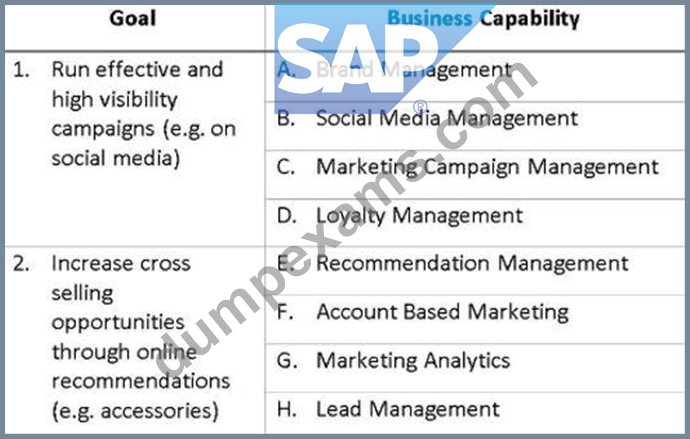

- A. 1-D-3,1-H- 2
- B. 1-B-3,1-C-3
- C. 2-A-4,1-F-2
- D. 2-E-3,2-G-3,2-B-3
Answer: B,C
NEW QUESTION # 37
As part of the mapping of a Business Architecture to the Solution Architecture, an Environment & Location Diagram must be developed in the Technology Architecture phase. In this context, numerous architecture decisions have to be made. Among other things, you must check which SAP BTP services and which SAP SaaS solutions are available as part of the Solution Architecture in which data center of the desired hyperscaler. How do you go about this validation?
- A. I use the SAP Discovery Center to check in which data centers the respective SAP BTP services and the SAP SaaS solutions are available.
- B. I use the SAP Discovery Center to check which of the selected SAP BTP services are offered by which hyperscaler. With help from the SAP Trust Center, I check in which data center the involved SAP SaaS solutions are available.
- C. I use the SAP Business Accelerator Hub (api.sap.com) because it provides all the required information regarding SAP BTP service and SAP SaaS solution availability for each hyperscaler, in a central location.
Answer: B
Explanation:
According to the SAP Discovery Center 1 and the SAP Trust Center 2, the steps involved in this validation are:
Use the SAP Discovery Center to check which of the selected SAP BTP services are offered by which hyperscaler. The SAP Discovery Center is a platform that provides access to SAP BTP services, events, and related resources, and helps you to implement your use cases on SAP BTP with step-by-step guidance and support from topic experts and SAP Community. In the Service Catalog section of the SAP Discovery Center, you can browse and filter the available SAP BTP services by category, region, or hyperscaler. You can also compare the features and pricing of different services, and learn how to use them in your projects.
Use the SAP Trust Center to check in which data center the involved SAP SaaS solutions are available. The SAP Trust Center is a platform that provides information on cloud performance, security, privacy, and compliance. In the Certification and Compliance section of the SAP Trust Center, you can find certificates, reports, and attestations that show how SAP meets various industry standards and regulatory requirements. You can also filter the documents by solution, region, or hyperscaler, and download them for your reference.
The other options (A and C) are not correct for how to validate the availability of SAP BTP services and SAP SaaS solutions in the desired hyperscaler's data center, because they either do not exist or do not provide the required information. For example:
Option A is not correct because there is no such platform as SAP Business Accelerator Hub (api.sap.com) that provides all the required information regarding SAP BTP service and SAP SaaS solution availability for each hyperscaler. The correct name of the platform is SAP API Business Hub (api.sap.com), which is a platform that provides access to SAP APIs, events, and related resources, but it does not provide any information on the availability of SAP BTP services or SAP SaaS solutions for each hyperscaler or data center.
Option C is not correct because the SAP Discovery Center does not provide any information on the availability of SAP SaaS solutions for each hyperscaler or data center. The SAP Discovery Center only provides information on the availability of SAP BTP services for each hyperscaler or region, but not for specific data centers. To check the availability of SAP SaaS solutions for each data center, you need to use the SAP Trust Center instead.
NEW QUESTION # 38
......
Pass Your SAP Certified Professional P-SAPEA-2023 Exam on Nov 05, 2024 with 49 Questions: https://passguide.dumpexams.com/P-SAPEA-2023-vce-torrent.html