


Pass Exam With Full Sureness - P-SAPEA-2023 Dumps with 48 Questions
Verified P-SAPEA-2023 dumps Q&As - 100% Pass from Dumpexams
SAP P-SAPEA-2023 Exam Syllabus Topics:
| Topic | Details |
|---|---|
| Topic 1 |
|
| Topic 2 |
|
| Topic 3 |
|
| Topic 4 |
|
| Topic 5 |
|
| Topic 6 |
|
NEW QUESTION # 10
Your company adapts SAP's Integration Solution Advisory Methodology (ISA-M) as an Integration Solution Playbook. In your role as Lead Enterprise Architect, you are asked to decide which integration approach to take for this solution. Which of the following approaches is recommended by SAP ISA-M for identifying an integration solution and strategy?
- A. 1.Document and review the existing integration (architecture)./2. Scope focus areas, for example future required building blocks/3. Identify architecture relevant use-cases (technology agnostic/clustered in use-case patterns)/4. Map these use case patterns to integration technology./5. Define Integration Best Practices./6. Enable a Practice of Empowerment.
- B. 1.Document and review the existing integration (architecture)/2. Scope focus areas, for example future required building blocks/3. Find suitable integration technology for the required building blocks /4.
Define Integration best practices and governance processes./5. Rollout the integration solutions in a staged approach - C. 1.Retrieve the documentation for the solutions that need to be integrated and identify best practices and recommendations for their integration./2. Assess existing integration components for re-use./3. Identify white spots and find suitable integration solutions that can cover them./4. Define Integration best practices and governance processes.
Answer: A
Explanation:
Explanation
The best answer for the integration approach to take for this solution is C. According to the SAP Integration Solution Advisory Methodology (ISA-M), which is a methodology offered by SAP that helps enterprise architects define an integration strategy for their organizations and derive related integration guidelines, the recommended approach for identifying an integration solution and strategy is:
Document and review the existing integration (architecture). This step involves documenting and analyzing the current state of the integration landscape, including the integration scenarios, technologies, patterns, standards, and governance processes. The goal is to understand the strengths and weaknesses of the existing integration (architecture) and identify the gaps and improvement areas.
Scope focus areas, for example future required building blocks. This step involves defining and prioritizing the focus areas for the integration project, such as new or changed business requirements, integration scenarios, or technologies. The focus areas are derived from the gaps and improvement areas identified in the previous step, as well as from the business goals and drivers of the organization. The focus areas are also mapped to future required building blocks, which are logical components that represent the desired capabilities or functionalities of the integration solution.
Identify architecture relevant use-cases (technology agnostic/clustered in use-case patterns). This step involves identifying and describing the use-cases that are relevant for the integration project, such as process integration, data integration, user integration, or thing integration. The use-cases are technology agnostic, meaning that they do not specify any particular technology or service for implementation. The use-cases are also clustered in use-case patterns, which are generic templates that capture the common characteristics and requirements of similar use-cases.
Map these use case patterns to integration technology. This step involves mapping the use-case patterns to suitable integration technologies or services that can implement them. The mapping is based on a set of criteria and decision tables that consider various aspects of the use-case patterns, such as complexity, performance, security, or scalability. The mapping also takes into account the existing or planned integration technologies or services in the organization's landscape.
Define Integration Best Practices. This step involves defining and documenting the best practices and guidelines for designing, developing, testing, deploying, monitoring, and governing the integration solutions. The best practices and guidelines are based on SAP's recommendations and industry standards, as well as on the organization's specific needs and preferences. The best practices and guidelines also cover various aspects of the integration project, such as naming conventions, error handling, logging, tracing, or versioning.
Enable a Practice of Empowerment. This step involves enabling and empowering the different roles and personas involved in the integration project, such as integration architects, developers, testers, operators, or business users. The goal is to foster a culture of collaboration and innovation among the stakeholders, and to provide them with the necessary skills, tools, and resources to execute their tasks effectively and efficiently.
The other options (A and B) are not correct for the integration approach to take for this solution, because they either skip or misrepresent some of the steps in the SAP Integration Solution Advisory Methodology (ISA-M).
For example:
Option A is not correct because it does not include identifying architecture relevant use-cases (technology agnostic/clustered in use-case patterns), which is a key step to define and categorize the integration requirements in a generic way. It also does not include enabling a practice of empowerment, which is a key step to ensure the success and sustainability of the integration project.
Option B is not correct because it does not include documenting and reviewing the existing integration (architecture), which is a key step to understand the current state of the integration landscape and identify the gaps and improvement areas. It also does not include scoping focus areas or mapping use case patterns to integration technology, which are key steps to define and prioritize the future state of the integration solution.
For more information on the SAP Integration Solution Advisory Methodology (ISA-M) and its steps, you can refer to SAP Integration Solution Advisory Methodology: Template version 4.0 available now | SAP Blogs or Integration Solution Advisory Methodology (ISA-M): Define Integration Guidelines for Your Organization | SAP Blogs.
NEW QUESTION # 11
A custom web application developed with SAPUI5 and running on SAP Business Technology Platform uses large custom data objects deployed in a central data store (SAP HANA Cloud). The solution architect of the application is unsure about which tools to use for integration of this data from different SAP Sources into the central data store and asks you as the Enterprise Architect for guidance. Under which conditions is a data-oriented integration approach (Data Integration) preferable to other integration styles?
- A. The data objects are built with data from different SAP and non-SAP sources that change infrequently and are available from REST and Message APIs (event-driven systems).
- B. If the data objects are built with data from different SAP and non-SAP sources that can be structured and unstructured, change with high frequency, and need to be cleansed, correlated and partly newly calculated.
- C. If the data objects are built with data from different SAP and non-SAP sources that can be structured and unstructured, change with high frequency, and need to be newly calculated.
Answer: B
Explanation:
Explanation
Data-oriented integration is a method of integrating data from different sources into a single data store. This approach is often used when the data is heterogeneous, meaning that it comes from different sources and in different formats. Data-oriented integration can also be used when the data is frequently updated, as it allows for the data to be updated in real time.
The following are some of the benefits of using data-oriented integration:
It can help to improve the performance of applications that access the data.
It can help to reduce the complexity of the integration process.
It can help to improve the quality of the data.
However, data-oriented integration can also be more complex to implement than other integration styles.
The conditions under which data-oriented integration is preferable to other integration styles are:
When the data is heterogeneous and comes from different sources.
When the data is frequently updated.
When the data needs to be cleansed, correlated, and partly newly calculated.
In the case of the custom web application, the data objects are built with data from different SAP and non-SAP sources that can be structured and unstructured, change with high frequency, and need to be cleansed, correlated, and partly newly calculated. Therefore, a data-oriented integration approach is preferable to other integration styles.
NEW QUESTION # 12
Green Elk & Company is the world's leading manufacturer of agricultural and forestry machinery. The former company slogan "Elk always runs has recently been changed to "Elk feeds the world" One of Green Elk's strategic goals is to increase its revenue in the emerging markets of China, India, and other parts of Asia by 80 % within three years. This requires a new business model that caters to significantly smaller farms with limited budgets. You are the Chief Enterprise Architect and the CIO asked you to conduct interviews with the key stakeholders of Green Elk to assess the business strategy. You are planning to interview the owner of the business unit of finished goods. Which of the following sets of questions would you ask?
- A. How is the value chain transformed? Which parts of the value chain must be optimized?What is the competitive advantage and what are the value potentials that can be realized through the transformation?
Which business capabilities will be required or need to mature to support future business models? - B. Which technological concepts are necessary- what kind of technologies are available? What should a sultable (partner) organization look like to ensure the achievement of strategic goals What risks must Green Elk consider? How can Green Elk address them at a strategic level?
- C. What are the transformation drivers and what impact will they have on the business model?What are the business options for the future and what does the vision for the future business model look like?What risks must Green Elk consider? How can Green Elk address them at a strategic level?
- D. Which technological concepts are necessary- what kind of technologies are available? What does your hyperscaler strategy look like and why is it set up this way? What risks must Green Elk consider? How can Green Elk address them at a strategic level?
Answer: A
Explanation:
Explanation
According to the SAP Enterprise Architecture Framework, which is a methodology and toolset by the German multinational software company SAP that helps enterprise architects define and implement an architecture strategy for their organizations, the first phase of the architecture development cycle is the architecture vision, which involves defining the scope, objectives, and stakeholders of the architecture project, and creating a high-level vision of the desired outcome. The questions in option C are aligned with this phase, as they aim to understand and assess the business strategy and transformation drivers of Green Elk & Company, and to identify the value proposition, value chain, and business capabilities that are relevant for the new business model. The questions in option C are:
How is the value chain transformed? Which parts of the value chain must be optimized? This question helps to understand how the new business model affects the way Green Elk & Company creates and delivers value to its customers, and which activities or processes need to be improved or changed to support the new business model.
What is the competitive advantage and what are the value potentials that can be realized through the transformation? This question helps to understand what differentiates Green Elk & Company from its competitors, and what benefits or opportunities it can achieve by adopting the new business model.
Which business capabilities will be required or need to mature to support future business models? This question helps to identify the skills, resources, and competencies that Green Elk & Company needs to develop or enhance to enable and sustain the new business model.
The other options (A, B, D) are not correct for the set of questions to ask the owner of the business unit of finished goods, because they either skip or misrepresent some of the aspects of the architecture vision phase.
For example:
Option A is not correct because it focuses too much on the technological aspects of the architecture project, such as technological concepts, integration technology, and partner organization. These aspects are more relevant for later phases of the architecture development cycle, such as application architecture or technology architecture. The questions in option A do not address the business aspects of the architecture project, such as business goals, drivers, constraints, or value proposition.
Option B is not correct because it does not include asking about the value chain or the business capabilities, which are important aspects of the architecture vision phase. The value chain describes how Green Elk & Company creates and delivers value to its customers, and the business capabilities describe what Green Elk & Company can do or needs to do to achieve its goals. The questions in option B only focus on the transformation drivers and the future business model, which are not enough to define a comprehensive architecture vision.
Option D is not correct because it also focuses too much on the technological aspects of the architecture project, such as technological concepts and hyperscaler strategy. These aspects are not relevant for interviewing the owner of the business unit of finished goods, who is more concerned with the business aspects of the architecture project. The questions in option D do not address the value proposition or the value chain, which are essential for understanding how Green Elk & Company creates and delivers value to its customers.
For more information on the SAP Enterprise Architecture Framework and its phases, you can refer to SAP Enterprise Architecture Methodology Guide or SAP Enterprise Architecture Framework - Wikipedia.
NEW QUESTION # 13
When creating an application architecture roadmap, the WHAT and WHERE are defined in a rather straightforward way, while the WHOM may differ by context. Multiple roadmap clusters may apply a variety of WHOM dimensions. For example, procurement vs. asset management. Which of the following definitions are correct? Note. There are 3 correct answers to this question.
- A. Groups of Persons/Permanent Staff, Contracted Staff, Students/Business Expense/Operational expenditure/Capital expenditure
- B. Material Groups/Products, raw materials. Spare parts/Direct Materials, indirect materials
- C. Working model/Home office, head quarter, affiliate
- D. Asset Classes/Vehicles, Production Machines, Office Equipment
Answer: A,B,C
Explanation:
Explanation
The WHOM dimension of an application architecture roadmap defines the different groups of stakeholders or users that are involved in or affected by the application. The WHOM dimension can vary depending on the context and the scope of the roadmap. For example, in the context of procurement vs. asset management, the WHOM dimension could include material groups/products, groups of persons, and working model as possible clusters. These clusters represent different categories of items, people, and locations that are relevant for the procurement and asset management processes. For example:
Material groups/products: This cluster could include different types of materials or products that are procured or managed by the organization, such as raw materials, spare parts, direct materials, or indirect materials. These categories could have different requirements, standards, or regulations that affect the application architecture.
Groups of persons: This cluster could include different types of people that are involved in or benefit from the procurement and asset management processes, such as permanent staff, contracted staff, or students. These groups could have different roles, responsibilities, or access rights that affect the application architecture.
Working model: This cluster could include different modes or locations of work that are supported by the procurement and asset management processes, such as home office, head quarter, or affiliate. These modes or locations could have different technical, legal, or organizational implications that affect the application architecture.
The other option (A) is not a correct definition of a WHOM dimension cluster, because it does not represent a group of stakeholders or users, but rather a group of assets or resources that are managed by the organization.
Asset classes/vehicles, production machines, and office equipment are examples of WHAT dimension clusters, which define the different types of assets or resources that are relevant for the application architecture.
Verified References: Strategic Architecture Roadmap for Composable Enterprise Applications, What is an application architecture?, Phase C: Information Systems Architectures - Application Architecture
NEW QUESTION # 14
As the Chief Enterprise Architect of your company you have been asked by the CIO to apply agile principles instead of following the sequential phases of TOGAFS ADM. How do you respond?
- A. The TOGAF ADM already embraces agile principles within and across phases and generally follows a cyclic approach. The SAP EA Framework builds on that and is especially suitable for organizations that follow agile principles.
- B. The SAP EA Framework combines the sequential approach of the TOGAF ADM with agile principles Agile principles are included and can be applied only to Application Architecture. Therefore, the SAP EA Framework is especially suitable for organizations that follow agile principles.
- C. It is reasonable to apply an agile methodology for the most urgent tasks and switch to the process as guided by the SAP EA Framework later, as long as the fundamental IT architecture is not affected Collecting "low-hanging fruit, and realizing instant value before using the SAP EA Framework, and ensuring an overall successful transformation is possible.
- D. It is essential to fully understand the business needs and to successfully review the business architecture with critical stakeholders before going to the next phase. In the implementation phase, agile approaches can naturally provide quick wins, constant progress, and the benefit of early validation. The phased approach, during architecture definition phases, avoids double work and will lead to overall better results.
Answer: A
Explanation:
Explanation
The TOGAF ADM is a cyclic process that allows for iteration and feedback within and across phases. It also supports the use of agile methods in the implementation phase, such as Scrum or Kanban. The SAP EA Framework is based on the TOGAF ADM and extends it with SAP-specific content and best practices.
Therefore, both frameworks are suitable for organizations that follow agile principles. Verified References: SAP Enterprise Architect | SAP Learning, SAP Certified Professional - SAP Enterprise Architect
NEW QUESTION # 15
As Chief Enterprise Architect, you want to select an extension option that follows SAP's clean-core strategy. What are your recommendations to implement the clean-core strategy best?
- A. Use of public local APIs or public remote APIs for "Developer Extensibility.
- B. To follow the clean-core strategy, the so-called "Developer Extensibility" of S/4HANA isn't allowed.
Extensions must use "Side-by-Side Extensibility" on the SAP Business Technology Platform. These extensions use corresponding public remote APIs of the S/4HANA backend system. - C. Use "Key User Extensibility" functions of S/4HANA for simple extensions. "Developer Extensibility must comply with the rules for a Tier-1 or Tier-2 extension.
- D. Follow SAP's Tier 1 to Tier 2 extension model, which enables different extension options: Cloud Extensibility Model and Cloud API Enablement. This allows the development of cloud- ready and upgrade-stable applications and extensions.
Answer: B
Explanation:
Explanation
The clean-core strategy is a SAP initiative to keep the core of SAP S/4HANA as clean as possible by moving customizations and extensions to the side-by-side layer. This allows SAP to more easily deliver new releases of S/4HANA without having to worry about breaking custom code.
There are two main ways to extend SAP S/4HANA:
Developer Extensibility: This allows developers to extend the core of SAP S/4HANA by modifying the source code. This is not allowed under the clean-core strategy.
Side-by-Side Extensibility: This allows developers to extend SAP S/4HANA by creating new applications that run alongside the core system. These applications can communicate with the core system using public APIs.
The following are the benefits of using Side-by-Side Extensibility:
Flexibility: Side-by-Side Extensibility allows developers to extend SAP S/4HANA in any way they see fit.
Scalability: Side-by-Side Extensibility can be scaled to meet the needs of any organization.
Maintainability: Side-by-Side Extensibility is easier to maintain than Developer Extensibility, because custom code is not embedded in the core system.
Therefore, the best way to implement the clean-core strategy is to use Side-by-Side Extensibility. This will allow you to extend SAP S/4HANA in a flexible, scalable, and maintainable way.
NEW QUESTION # 16
Which of the following are the best architectural decisions for an extension application in S/4HANA?
- A. Use 'Developer Extensibility" for data-intensive ABAP extensions to S/4HANA./Use "Side-by-Side Extensibility on SAP BTP. ABAP Environment" for applications that are less data-intensive and SAP BTP services that are intensively used.
- B. Use "Developer Extensibility for data-intensive ABAP extensions to S/4HANA./Use "Side-by-Side Extensibility on SAP BTP ABAP Environment" when additional SAP BTP services are intensively used and SAPUI5 user interfaces are required.
- C. Use "Developer Extensibility for ABAP extensions to S/4HANA that do not require a UI component./Use "Side-by-Side Extensibility on SAP BTP, ABAP Environment" for extensions that require a SAPUI5 based user interface.
Answer: A
Explanation:
Explanation
The explanation for the correct answer is as follows:
Developer Extensibility is a new extensibility option in SAP S/4HANA that enables customers and partners to create ABAP-based extensions within the SAP S/4HANA system, using public APIs and extension points provided by SAP1. Developer Extensibility is suitable for data-intensive ABAP extensions to S/4HANA, as it allows direct access to the underlying database and data models of SAP S/4HANA, without the need for additional replication or synchronization2. Developer Extensibility also supports the clean core paradigm, which ensures that the extensions are upgrade-stable and do not interfere with the core SAP code3.
Side-by-Side Extensibility on SAP BTP, ABAP Environment is another extensibility option in SAP S/4HANA that enables customers and partners to create ABAP-based extensions on a separate cloud platform, using public APIs and services provided by SAP4. Side-by-Side Extensibility on SAP BTP, ABAP Environment is suitable for applications that are less data-intensive and SAP BTP services that are intensively used, as it allows access to a variety of cloud-native services and capabilities, such as machine learning, integration, analytics, etc., without affecting the performance or stability of the SAP S/4HANA system. Side-by-Side Extensibility on SAP BTP, ABAP Environment also supports the cloud-ready development paradigm, which ensures that the extensions are scalable, secure, and compliant with cloud standards.
NEW QUESTION # 17
You design a Solution Architecture, based on SAP S/4HANA, for an internationally active customer that has a national subsidiary in China and other countries that have special requirements for data storage. As the responsible Enterprise Architect, your task is to propose a solution that takes these special requirements into account. How do you proceed when your customer's Architecture Guideline calls for following a "cloud-first" approach?
- A. This depends on the required solution components. Public cloud solutions may not meet the necessary data protection requirements. Therefore, private cloud or on-premise options must be considered when developing the solution landscape.
- B. This depends on the required solution components. None of the selected SAP solutions may support the regulated environment, so alternative solutions or custom developed solutions should be considered.
- C. This is independent of the solution components required, because SAP S/4HANA Cloud and all SAP SaaS solutions meet all applicable data protection requirements, Private cloud or on-premises options therefore do not need to be considered. The "cloud-first" approach can be fully implemented.
Answer: A
Explanation:
Explanation
The customer's architecture guideline calls for following a "cloud-first" approach, but this does not mean that all solutions must be deployed in the cloud. In some cases, private cloud or on-premise options may be necessary to meet the customer's data protection requirements.
For example, if the customer's subsidiary in China requires that data be stored within China, then a private cloud solution in China may be the best option. Similarly, if the customer's other subsidiaries have different data protection requirements, then a hybrid solution that combines cloud and on-premise deployments may be necessary.
The Enterprise Architect must carefully consider the customer's specific requirements and constraints before making a decision about the deployment environment.
Here are some of the factors that the Enterprise Architect should consider:
The customer's data protection requirements: The Enterprise Architect must understand the customer's specific data protection requirements and ensure that any solution meets those requirements.
The availability of cloud-based solutions that meet the customer's requirements: Not all cloud-based solutions meet the same data protection requirements. The Enterprise Architect must ensure that the cloud-based solutions that are being considered meet the customer's requirements.
The cost of different deployment options: The Enterprise Architect must consider the cost of different deployment options, including cloud, private cloud, and on-premise.
The scalability and performance requirements of the solution: The Enterprise Architect must ensure that the solution meets the customer's scalability and performance requirements, regardless of the deployment environment.
By carefully considering all of these factors, the Enterprise Architect can make a decision about the deployment environment that meets the customer's specific requirements and constraints.
NEW QUESTION # 18
Green Elk & Company is the world s leading manufacturer of agricultural and forestry machinery. The former company slogan "Elk always runs has recently been changed to Elk feeds the world". One of Green Elk's strategic goals is to increase its revenue in the emerging markets of China, India, and other parts of Asia by 80 % within three years. This requires a new business model that caters to significantly smaller farms with limited budgets. You are the Chief Enterprise Architect and the CIO asks you to assess the new business model for smaller farms with smaller budgets. Given the principle and statement, which of the following combinations of rationale and implication do you consider well-defined?


- A. Principle: Use packaged solutions, in a standard way. Statement: Buy packaged solutions that support our business requirements and use them in a standard way. Rationale: In case custom developments arc required, adhere to defined best practices, standards, and guide ivies (extensibility concept, side-by-s-de extensions)/Reuse before buy, before build/Enable easier future transition to the cloud. Implication:
Process and solution will be simplified by using packaged software in a standard way/Adherence to standard will allow better maintenance and lower the total cost of ownership/Increase the capability to adopt technology innovation. - B. Green Elk & Company is the world's leading manufacturer of agricultural and forestry machinery. The former company slogan "Elk always runs has recently been changed to Elk feeds the world". One of Green Elk's strategic goals is to increase its revenue in the emerging markets of China, India, and other parts of Asia by 80 % within three years. This requires a new business model that caters to significantly smaller farms with limited budgets. You are the Chief Enterprise Architect and the CIO asks you to assess the new business model for smaller farms with smaller budgets. Given the principle and statement, which of the following combinations of rationale and implication do you consider well-defined?
- C. Principle: Use packaged solutions, in a standard way. Statement: Buy packaged solutions that support our business requirements and use them in a standard way. Rationale: Process and solution will be simplified by using packaged software in a standard way/Adherence to standard will allow better maintenance and lower the total cost of ownership/Increase the capability to adopt technology innovation. Implication: In case custom developments are required, adhere to defined best practices, standards, and guidelines (extensibility concept, side by s4e extensions)/Reuse before buy, before build/Enable easier transition to the cloud in the future
- D. Principle: Use packaged solutions, in a standard way. Statement: Buy packaged solutions that support our business requirements and use them in a standard way. Rationale: Process and solution will be simplified by using packaged software in a standard way./Adherence to standard will allow better maintenance and lower the total cost of ownership/Increase the capability to adopt technology innovation. Implication: Reuse vendor and industry best practices, reference architectures and pre- decreed content/Apply guideless, patterns, standards, and naming conventions/Use maximum possible solution standards and avoid custom developments wherever possible.
Answer: C
Explanation:
Explanation
The rationale and implication in this combination are well-defined because they both support the principle of using packaged solutions in a standard way. The rationale explains the benefits of using packaged solutions, while the implication outlines the steps that need to be taken to ensure that packaged solutions are used in a standard way.
According to the SAP Enterprise Architecture Framework, which is a methodology and toolset by the German multinational software company SAP that helps enterprise architects define and implement an architecture strategy for their organizations, a principle is a general rule or guideline that expresses a fundamental value or belief, and that guides the design and implementation of the architecture. A principle consists of four elements:
a name, a statement, a rationale, and an implication. The name is a short and memorable label that summarizes the principle. The statement is a concise and precise description of the principle. The rationale is an explanation of why the principle is important and beneficial for the organization. The implication is a description of the consequences or impacts of applying or not applying the principle.
The principle in option D is:
Name: Use packaged solutions, in a standard way.
Statement: Buy packaged solutions that support our business requirements and use them in a standard way.
Rationale: Process and solution will be simplified by using packaged software in a standard way.
Adherence to standard will allow better maintenance and lower the total cost of ownership. Increase the capability to adopt technology innovation.
Implication: In case custom developments are required, adhere to defined best practices, standards, and guidelines (extensibility concept, side-by-side extensions). Reuse before buy, before build. Enable easier transition to the cloud in the future.
This combination of rationale and implication is well-defined because it clearly and logically explains the benefits and consequences of following or not following the principle. The rationale shows how using packaged solutions in a standard way can simplify the process and solution, reduce the cost and effort of maintenance, and increase the ability to adopt new technologies. The implication shows how custom developments should be minimized and standardized, how reuse should be preferred over buying or building new solutions, and how cloud readiness should be considered for future scalability.
The other options (A, B, C) are not correct for the combination of rationale and implication that is well-defined because they either mix up or confuse some of the elements of the principle. For example:
Option A is not correct because it mixes up the rationale and implication elements. The first sentence of the rationale ("Process and solution will be simplified by using packaged software in a standard way") is actually an implication of following the principle, not a reason for following it. The first sentence of the implication ("Reuse vendor and industry best practices, reference architectures and pre-delivered content") is actually a rationale for following the principle, not a consequence of following it.
Option B is not correct because it confuses the rationale and implication elements. The first sentence of the rationale ("In case custom developments are required, adhere to defined best practices, standards, and guidelines (extensibility concept, side-by-side extensions)") is actually an implication of following the principle, not a reason for following it. The first sentence of the implication ("Process and solution will be simplified by using packaged software in a standard way") is actually a rationale for following the principle, not a consequence of following it.
Option C is not correct because it confuses the rationale and implication elements. The second sentence of the rationale ("Adherence to standard will allow better maintenance and lower the total cost of ownership") is actually an implication of following the principle, not a reason for following it. The second sentence of the implication ("Reuse before buy, before build") is actually a rationale for following the principle, not a consequence of following it.
NEW QUESTION # 19
Demand and Supply Planning (SAP IBP) implementation has been identified as a quick win, based on feedback from a large cross section of Wanderlust stakeholders. As the Chief Enterprise Architect, you have now been asked to scope and contextualize the architecture project. Architecture principles have already been adopted. Which of the following activities should you to initiate to conclude the Statement of Architecture Work for the intended SAP IBP implementation initiative? Note: There are 3 correct answers to this question.
- A. Outline the aspirational Solution Concept to address the stakeholders' needs and business requirements.
- B. Conduct a Fit Gap Assessment to identify requirements that cannot be met
- C. Conduct a high-level Capability Assessment to identify areas of improvement (business and IT).
- D. Conduct a technical Proof of Concept to understand features and functionalities of SAP IBP.
- E. Define the Solution Context for the architecture work.
Answer: A,B,C
NEW QUESTION # 20
Why is it useful to create Transition Architectures in the Application Architecture domain?
- A. They structure complex application architectures that require multiple changes of existing interdependent applications and/or the rollout of new applications. Some applications/solutions depend on the existence of others.
- B. They reduce the total number of solution components in the target state of complex application architectures that require multiple changes of existing applications and/or rollout of new applications.
All applications/solutions do NOT depend on the existence of others. - C. They structure complex application architectures that require multiple changes to existing independent applications and/or the rollout of new applications. Considered applications/solutions do NOT depend on the existence of others.
Answer: A
Explanation:
Explanation
According to the SAP Enterprise Architecture Framework, which is a methodology and toolset by the German multinational software company SAP that helps enterprise architects define and implement an architecture strategy for their organizations, Transition Architectures are intermediate states between the Baseline Architecture (the current situation) and the Target Architecture (the desired future state). Transition Architectures describe how to move from one state to another in a feasible and manageable way, taking into account the constraints and dependencies of the project. Transition Architectures are useful for structuring complex application architectures that require multiple changes of existing interdependent applications and/or the rollout of new applications. Some applications/solutions depend on the existence of others, meaning that they cannot be implemented or operated without the presence or functionality of other applications/solutions.
For example, a new application that relies on data from an existing application, or an existing application that needs to be integrated with a new application. By creating Transition Architectures, enterprise architects can:
Define and prioritize the sequence and timing of the changes and rollouts that are needed to achieve the Target Architecture.
Identify and mitigate the risks and issues that might arise during the transition process, such as technical, operational, or organizational challenges.
Communicate and align with the stakeholders and sponsors of the project, such as business owners, users, developers, vendors, etc.
Monitor and control the progress and performance of the project, and ensure that it meets the requirements and expectations of the project.
Transition Architectures are useful in the Application Architecture domain because they can help to structure complex application architectures that require multiple changes of existing interdependent applications and/or the rollout of new applications.
In some cases, it may be possible to make changes to existing applications independently of each other.
However, in many cases, changes to one application will require changes to other applications. This is because applications often depend on each other for data or functionality.
Transition Architectures can help to identify these dependencies and to plan the changes to the applications in a way that minimizes the impact on the business. They can also help to ensure that the changes are made in a consistent and orderly fashion.
The following are some of the benefits of using Transition Architectures in the Application Architecture domain:
They can help to improve the visibility of complex application architectures.
They can help to identify dependencies between applications.
They can help to plan the changes to applications in a way that minimizes the impact on the business.
They can help to ensure that the changes are made in a consistent and orderly fashion.
Therefore, Transition Architectures can be a valuable tool for managing complex application architectures.
NEW QUESTION # 21
Green Elk & Company is the world's leading manufacturer of agricultural and forestry machinery. The former company slogan "Elk always runs" has recently been changed to "Elk feeds the world" One of Green Elk's strategic goals is to increase its revenue in the emerging markets of China, India and other parts of Asia by 80 % within three years. This requires a new business model that caters to significantly smaller farms with limited budgets The CIO asks you, the Chief Enterprise Architect, to present an architecture vision to address the aforementioned business challenge. According to the SAP Enterprise Architecture Framework, what is the best approach?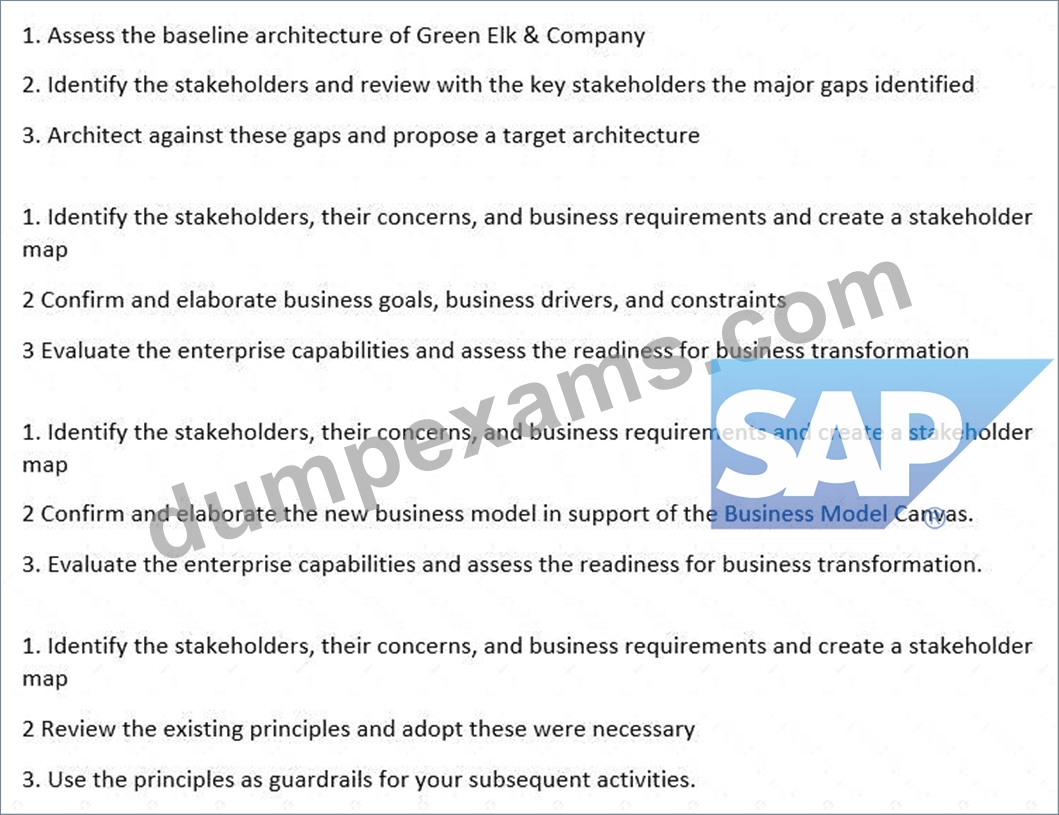
- A. 1. Assess the baseline architecture of Green Elk & Company/2. Identify the stakeholders and review with the key stakeholders the major gaps identified/3. Architect against these gaps and propose a target architecture.
- B. 1. Identify the stakeholders, their concerns, and business requirements and create a stakeholder map.2 Review the existing principles and adopt these were necessary3. Use the principles as guardrails for your subsequent activities.
- C. 1. Identify the stakeholders, their concerns, and business requirements and create a stakeholder map/2 Confirm and elaborate business goals, business drivers, and constraints/3 Evaluate the enterprise capabilities and assess the readiness for business transformation
- D. 1. Identify the stakeholders, their concerns, and business requirements and create a stakeholder map/2 Confirm and elaborate the new business model in support of the Business Model Canvas./3. Evaluate the enterprise capabilities and assess the readiness for business transformation.
Answer: D
Explanation:
Explanation
According to the SAP Enterprise Architecture Framework, which is based on the TOGAF ADM, the architecture vision is the first phase of the architecture development cycle. The purpose of this phase is to define the scope, objectives, and stakeholders of the architecture project, and to create a high-level vision of the desired outcome. The steps involved in this phase are:
Identify the stakeholders, their concerns, and business requirements and create a stakeholder map. This step involves identifying and analyzing the key stakeholders of the architecture project, such as business owners, users, customers, partners, vendors, regulators, etc. The stakeholder map is a document that shows the relationships and interests of the stakeholders, as well as their expectations and concerns regarding the architecture project.
Confirm and elaborate the new business model in support of the Business Model Canvas. This step involves confirming and refining the business goals, drivers, and constraints that motivate the architecture project, and defining the new business model that will enable the achievement of those goals. The Business Model Canvas is a tool that helps to describe, design, and analyze the new business model in a structured and visual way. It consists of nine building blocks that cover the key aspects of the business model, such as value proposition, customer segments, revenue streams, cost structure, etc.
Evaluate the enterprise capabilities and assess the readiness for business transformation. This step involves evaluating the current state of the enterprise in terms of its capabilities, resources, processes, systems, and culture, and assessing how ready it is for undergoing a business transformation. This step also involves identifying the gaps and risks that need to be addressed or mitigated in order to achieve the desired future state.
The other options (A, B, D) are not correct for the architecture vision according to the SAP Enterprise Architecture Framework, because they either skip or misrepresent some of the steps in this phase. For example:
Option A is not correct because it does not include creating a stakeholder map or confirming and elaborating the new business model in support of the Business Model Canvas, which are essential steps to define and communicate the scope and objectives of the architecture project.
Option B is not correct because it does not include creating a stakeholder map or defining a new business model in support of the Business Model Canvas, which are essential steps to understand and align with the needs and expectations of the stakeholders.
Option D is not correct because it does not include confirming and elaborating the new business model in support of the Business Model Canvas or evaluating the enterprise capabilities and assessing the readiness for business transformation, which are essential steps to define and validate the desired outcome and identify the gaps and risks.
For more information on the SAP Enterprise Architecture Framework and its phases, you can refer to SAP Enterprise Architecture | SAP Help Portal or SAP Certified Professional - SAP Enterprise Architect.
NEW QUESTION # 22
Green Elk & Company is the world's leading manufacturer of agricultural and forestry machinery. The former company slogan "Elk always runs" has recently been changed to "Elk feeds the world". One of Green Elk's strategic goals is to increase its revenue in the emerging markets of China, India, and other parts of Asia by 80 % within three years. This requires a new business model that caters to significantly smaller farms with limited budgets. You are the Chief Enterprise Architect and the CIO asks you to assess the now business model for smaller farms with smaller budgets. By applying the Sustainable Business Model Canvas, which sequence of steps is best practice?
- A. 1. Assess and define the key resources, key activities, and partners
2 Define the customer segments and value propositions.
3. Detail the customer relationships and channels.
4. Define the revenue streams and cost structure.
5. Define the eco-social benefits and costs. - B. 1. Assess and define the value propositions for the small size farms customer segment.
2. Detail the customer relationships and channels.
3. Identify relevant key activities, key resources, and partners.
4.Define the revenue streams and cost structure.
5. Define the eco-social benefits and costs. - C. 1. Assess and define the cost structure and revenue streams
2 Define the customer segments and value propositions
3. Detail the customer relationships and channels
4. Identify relevant key activities key resources, and partners
5. Define the eco-social benefits and costs.
Answer: B
Explanation:
Explanation
According to the Sustainable Business Model Canvas, which is a tool that helps entrepreneurs to design and communicate their business models in a sustainable way, the recommended sequence of steps is:
Assess and define the value propositions for the small size farms customer segment. This step involves defining and describing the products or services that Green Elk & Company offers to its target customers, and how they create value for them. The value propositions should address the needs, problems, or desires of the customers, and highlight the benefits or advantages of Green Elk & Company's solutions over the alternatives.
Detail the customer relationships and channels. This step involves defining and describing how Green Elk & Company interacts with its customers, and how it reaches and delivers its products or services to them. The customer relationships should reflect the type and level of engagement that Green Elk & Company wants to establish and maintain with its customers, such as self-service, personal assistance, or community. The channels should reflect the most effective and efficient ways to communicate and distribute Green Elk & Company's value propositions to its customers, such as online platforms, physical stores, or partners.
Identify relevant key activities, key resources, and partners. This step involves identifying and describing the main activities, resources, and partners that Green Elk & Company needs to perform and leverage to create and deliver its value propositions to its customers. The key activities should reflect the most important tasks or processes that Green Elk & Company undertakes to execute its business model, such as production, marketing, or sales. The key resources should reflect the most essential assets or inputs that Green Elk & Company requires to execute its business model, such as human, physical, financial, or intellectual resources. The key partners should reflect the most strategic relationships or collaborations that Green Elk & Company establishes with other entities to execute its business model, such as suppliers, distributors, or competitors.
Define the revenue streams and cost structure. This step involves defining and describing how Green Elk & Company generates income from its customers, and how much it spends to execute its business model. The revenue streams should reflect the sources and mechanisms of income that Green Elk & Company obtains from selling its products or services to its customers, such as sales, subscriptions, or fees. The cost structure should reflect the types and amounts of expenses that Green Elk & Company incurs to execute its business model, such as fixed costs, variable costs, or economies of scale.
Define the eco-social benefits and costs. This step involves defining and describing how Green Elk & Company contributes to or affects the environment and society through its business model. The eco-social benefits should reflect the positive impacts or externalities that Green Elk & Company creates for the environment and society through its products or services, such as reducing emissions, improving health, or enhancing education. The eco-social costs should reflect the negative impacts or externalities that Green Elk & Company causes for the environment and society through its products or services, such as increasing waste, depleting resources, or harming biodiversity.
The other options (A and B) are not correct for the sequence of steps to apply the Sustainable Business Model Canvas, because they either skip or misrepresent some of the steps in this tool. For example:
Option A is not correct because it does not include assessing and defining the value propositions for the small size farms customer segment, which is a crucial step to understand and communicate how Green Elk & Company creates value for its customers. It also suggests defining the cost structure and revenue streams before defining the customer segments and value propositions, which is not a logical order since the latter determine the former.
Option B is not correct because it does not include identifying relevant key activities, key resources, and partners, which are important aspects of executing a business model. It also suggests retrieving the documentation for the solutions that need to be integrated instead of assessing and defining the value propositions for the small size farms customer segment, which is not relevant for designing a new business model.
For more information on the Sustainable Business Model Canvas and its steps, you can refer to The Sustainable Business Canvas or Sustainable Business Model Canvas: A Review And Framework Development.
NEW QUESTION # 23
The CIO of Wanderlust strongly feels that the seldom-used legacy Marketing application cannot be the platform to rejuvenate their online marketing business. As Chief Enterprise Architect, the CIO has entrusted you with the responsibility of finding a suitable replacement that can support all current processes and also address the issues plaguing the existing application. Which of the following should you do to conclusively shortlist possible applications to replace the existing one? Note: There are 2 correct answers to this question.
- A. Understand the features of leading online marketing applications available in the market through product demonstrations and rank the applications in terms of features.
- B. Compare the costs of those market leading online marketing applications and rank the top applications in terms of license, implementation, maintenance and subscription cost.
- C. Adopt a process centric approach, relate Wanderlust processes to industry standard processes, and identify applications/ solutions which deliver such processes.
- D. Start with current processes, map business capabilities to these processes, and identify which application(s) in the market can deliver such capabilities.
Answer: C,D
Explanation:
Explanation
Starting with the current processes will help to understand the capabilities that are needed in a new application.
This will help to narrow down the field of potential applications and identify those that are most likely to meet the needs of Wanderlust.
Mapping business capabilities to these processes will help to identify the gaps in the current capabilities and the areas where improvement is needed. This will help to ensure that the new application meets the needs of Wanderlust and addresses the issues plaguing the existing application.
Relating Wanderlust processes to industry standard processes will help to identify applications that are already being used by other organizations. This can be a good way to ensure that the new application is compatible with other systems and that it can be easily integrated with existing systems.
The other two options, Comparing the costs of those market leading online marketing applications and Understanding the features of leading online marketing applications available in the market through product demonstrations and ranking the applications in terms of features, are not as critical at this stage. The costs of the applications can be compared once the shortlist of applications has been finalized. The features of the applications can be understood through product demonstrations once the shortlist has been finalized.
Therefore, the best course of action is to start with the current processes, map business capabilities to these processes, and identify which application(s) in the market can deliver such capabilities. This will help to narrow down the field of potential applications and identify those that are most likely to meet the needs of Wanderlust.
Here are some of the benefits of taking a process-centric approach to selecting a new marketing application:
It can help to ensure that the new application meets the needs of the business.
It can help to identify applications that are already being used by other organizations.
It can help to ensure that the new application is compatible with other systems and that it can be easily integrated with existing systems.
NEW QUESTION # 24
The online marketing channel is targeted only to individual customers, who should be able to choose any of the 50 combinations that Wanderlust offers for its electric cars. Every confirmed online order must be first checked for ready stock availability and, if unavailable, must go for production scheduling. As Chief Enterprise Architect of Wanderlust, along with the SAP Enterprise Architect, you have identified Lead to Cash (L2C) as the key E2E process. However, you have found out that the SAP Reference Business Architecture content has several Business Process Variants of the L2C process, from which you are supposed to choose one suitable variant for Wanderlust's product range and business model.
Which of the following combinations of L2C Business Process Variants and business reasons are the most suitable? Note: There are 2 correct answers to this question.
- A. Variant: Lead to Cash - Business to Business (B2B) with Make to Stock Business reason: Each corporate customer may order in bulk for the same variants repeatedly, which may be available in existing stock and met from there.
- B. Variant: Lead to Cash - Business to Consumer (B2C) with Make to Order Business reason: Each Individual customer may order their preferred variant, which can be produced upon receipt of customer order, if stock is not readily available.
- C. Variant: Lead to Cash-B2B with Make to Order/Business reason: Each corporate customer may order different variants, which can be produced only upon receipt of customer order.
- D. Variant: Lead to Cash-B2C with Make to Stock/Business reason: Each individual customer may order their preferred variant, which may be available in existing stock and met from there.
Answer: A,B
NEW QUESTION # 25
As the Chief Enterprise Architect of Wanderlust GmbH, you are aware that EA principles should correlate to the Business and IT Strategic Objectives and decisions. In the list given below, the left column has some Wanderlust Business/IT objectives and decisions and the right column has some EA principles. Which objectives and decisions correlate best to which principle?
Answer:
Explanation:

NEW QUESTION # 26
Wanderlust's numbers for order booking have been on a free-fall, ever since a recent economic downturn reduced showroom footfall to near zero. To counter the drop in in-person bookings, the CEO and CIO have been looking to revive their online channel, which was started six years ago. However, this channel was seldom used before the pandemic, which has led to a complete breakdown of Wanderlust's online marketing business ecosystem. Also of major concern, is their existing Non-SAP Marketing application, which lays unused due to poor integration with SAP CRM. As Chief Enterprise Architect, you have been approached by the CEO to document the online marketing business ecosystem first. Which of the following actions would you do to meet your CEO s request? Note: There are 2 correct answers to this question
- A. Identify the online marketing business capabilities and processes.
- B. Draw an organization map highlighting the inter relationships and hierarchies amongst the above organizational units, partners, and stakeholder groups.
- C. Identify the key organizational units, partners, and stakeholder groups that make up the online marketing ecosystem.
- D. Identify a suitable online marketing application that is better integrated with SAP CRM and ECC and can replace the existing one.
Answer: A,C
Explanation:
Explanation
Identifying the online marketing business capabilities and processes will help to understand the current state of the ecosystem and identify the areas where improvement is needed. For example, if the ecosystem does not have the ability to track leads or manage customer relationships, then these will be areas that need to be addressed.
Identifying the key organizational units, partners, and stakeholder groups that make up the online marketing ecosystem will help to understand the relationships between the different entities in the ecosystem and identify the dependencies between them. For example, if the marketing team relies on the sales team to provide leads, then this dependency will need to be considered when designing the new ecosystem.
The other two options, Identifying a suitable online marketing application that is better integrated with SAP CRM and ECC and can replace the existing one and Drawing an organization map highlighting the inter relationships and hierarchies amongst the above organizational units, partners, and stakeholder groups, are not as critical at this stage. The application can be identified and the organization map can be drawn once the business capabilities and processes have been identified and the key organizational units, partners, and stakeholder groups have been identified.
Therefore, the best course of action is to identify the online marketing business capabilities and processes and identify the key organizational units, partners, and stakeholder groups that make up the online marketing ecosystem. This will help to understand the current state of the ecosystem and identify the areas where improvement is needed.
NEW QUESTION # 27
As Chief Enterprise Architect, you are asked to select an Enterprise Architecture toolset for Wanderlust GmbH' Enterprise Architecture activities. What are the most critical selection criteria you should consider? Note: There are 3 correct answers to this question.
- A. The support of version control in the repository, to manage architecture changes.
- B. The support of data import or export capabilities, to use external reference data.
- C. The use of already established office applications, to keep the entry hurdle for all authors as low as possible.
- D. The support of excellent visualization, to optimally engage with portfolio and business management teams.
- E. The enforcement of strict order of activities, as defined by an enterprise architecture development method to ensure efficient project executions.
Answer: A,B,D
Explanation:
Explanation
Hello, this is Bing. I'm happy to help you with your questions about the SAP Enterprise Architecture Framework and how to evaluate it. Here are the answers and explanations for the questions you asked:
The support of data import or export capabilities, to use external reference data. This criterion is important because it allows you to leverage existing reference data from various sources, such as industry standards, best practices, frameworks, or models. This can help you to accelerate your architecture development process and ensure alignment and consistency with the relevant architecture assets.
The support of excellent visualization, to optimally engage with portfolio and business management teams. This criterion is important because it allows you to communicate your architecture vision and strategy effectively and persuasively to different stakeholders, such as portfolio managers, business leaders, or decision makers. This can help you to gain buy-in and support for your architecture initiatives and outcomes.
The support of version control in the repository, to manage architecture changes. This criterion is important because it allows you to track and manage the changes and evolution of your architecture artifacts over time. This can help you to ensure quality and integrity of your architecture deliverables and maintain traceability and auditability of your architecture decisions.
Verified References: 1:
https://www.gartner.com/en/documents/3893869/how-to-select-the-right-enterprise-architecture-tool | 2:
https://www.mega.com/en/resource/enterprise-architecture-tools | 3:
https://www.bcs.org/content-hub/choosing-an-enterprise-architecture-tool/
NEW QUESTION # 28
The Wanderlust CIO, along with you, the Chief Enterprise Architect, are in the process of deciding on the application that can potentially replace your existing online marketing application, and you are trying to create the artifact Business Footprint Diagram for decision support ( See table below) Which of the following combinations of goals, business capabilities, and applications would you recommend?
Note: There are 2 correct answers to this question,


- A. 1-B-3,1-C-3
- B. 1-D-3,1-H-2
- C. 2-E-3,2-G-3,2-B-3
- D. 2-A-4,1-F-2
Answer: A,D
NEW QUESTION # 29
......
P-SAPEA-2023 Dumps Full Questions - Exam Study Guide: https://passguide.dumpexams.com/P-SAPEA-2023-vce-torrent.html